





What's Happening?
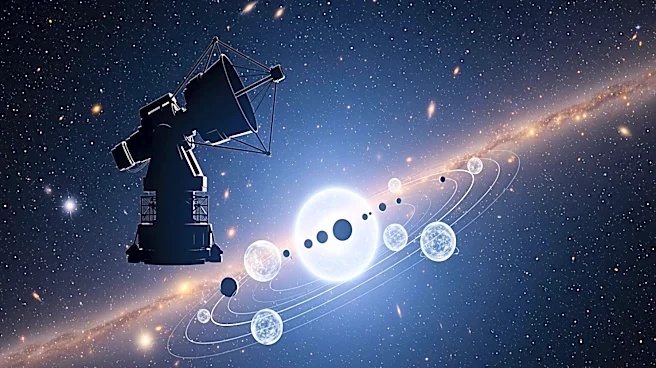
Astronomers have discovered that the interstellar comet 3I/ATLAS contains water with a high deuterium content, suggesting it formed in a much colder environment than our solar system. This finding, published in Nature Astronomy, indicates that the comet's
birthplace was significantly colder than the regions that formed Earth and other solar system bodies. The study, led by Luis Salazar Manzano from the University of Michigan, used observations from the Atacama Large Millimeter/submillimeter Array (ALMA) to analyze the comet's chemical composition. The deuterium-to-hydrogen ratio in 3I/ATLAS is at least 30 times higher than in any comet from our solar system, providing insights into the diverse conditions of planetary system formation across the galaxy.
Why It's Important?
The discovery of 3I/ATLAS's unique chemical signature offers a rare glimpse into the conditions of planetary systems beyond our own. By studying interstellar comets like 3I/ATLAS, scientists can gain direct samples of material formed around other stars, which could reshape our understanding of planet and comet formation. This research highlights the variability in water chemistry across different systems, challenging existing models of galaxy evolution and the conditions necessary for habitable worlds. The findings emphasize the importance of preserving dark skies to continue detecting such faint interstellar objects.