



What's Happening?
The International Finance Corporation (IFC), the private lending arm of the World Bank, has withdrawn a $20 million loan intended for Brazil’s Grupo Agronorte. This decision follows accusations from a coalition of environmental groups that the animal
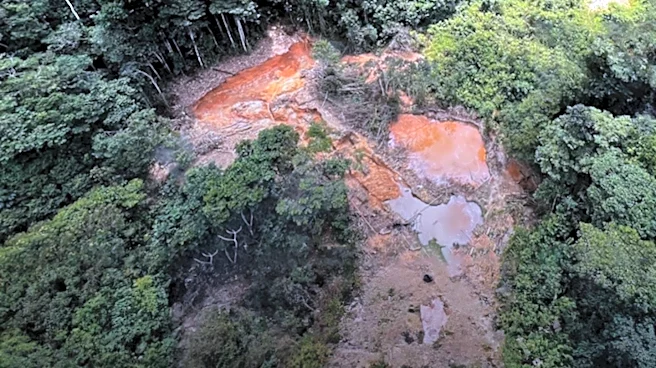
feed mill is linked to deforestation. The IFC had announced the loan in March 2026, but over 100 advocacy and Indigenous groups, organized by the Stop Financing Factory Farming coalition, urged its cancellation in May 2026. Environmentalists claim the IFC has since removed the loan details from its disclosure portal. Grupo Agronorte operates a mill that processes soya for farmed animal feed, and critics argue that its operations contribute to increased pressure for soya production, leading to deforestation in regions like the Amazon and Cerrado. The IFC itself acknowledged that Agronorte lacked systems to ensure its soyabeans were not sourced from illegally deforested land. An Apinajé chief reported that land claimed by Agronorte's owner, overlapping with their territory, is now completely deforested.
Why It's Important?
This withdrawal signals a growing pressure on international development banks to scrutinize the environmental impact of their investments, particularly concerning deforestation and industrial agriculture. The decision highlights the influence of environmental and Indigenous advocacy groups in holding financial institutions accountable for their role in global supply chains. The World Bank Group, including the IFC, has invested approximately $1.4 billion in farmed animal production in developing countries between 2023 and 2024, with the IFC approving nearly $2 billion in industrial farmed animal investments from 2020 to 2025. This incident could set a precedent for future investment decisions, potentially leading to stricter environmental safeguards and due diligence processes for projects in sectors linked to land-use change. It also underscores the ongoing conflict between agricultural expansion for animal feed and the preservation of critical ecosystems and Indigenous territories.
What's Next?
The withdrawal of this loan may encourage further scrutiny of other IFC investments in the agricultural sector, particularly those related to animal feed production. The Stop Financing Factory Farming coalition is currently monitoring a $150 million IFC loan to New Hope Singapore Pte. Ltd. for expanding animal feed production across several Asian and African countries. This suggests that environmental groups will continue to pressure development banks to align their financing with climate and environmental goals. Development banks may face increased demands to implement more robust environmental and social impact assessments and to ensure that their clients have verifiable systems in place to prevent deforestation and other harmful practices. This could lead to a shift in investment priorities within these institutions, favoring more sustainable agricultural practices or alternative food systems.
Beyond the Headlines
This event reflects a broader global trend where financial institutions are increasingly being held responsible for the indirect environmental and social impacts of their investments. It highlights the complex interplay between global food demand, agricultural supply chains, deforestation, and Indigenous rights. The reliance on soya for animal feed, often grown on deforested land, presents a significant challenge to global sustainability efforts. The withdrawal of the loan, while a specific action, points to a potential systemic shift where the financial sector may be forced to internalize the environmental costs of its lending. This could lead to a re-evaluation of what constitutes 'sustainable development' within these institutions and a greater emphasis on investments that do not exacerbate climate change or biodiversity loss, potentially influencing global agricultural policies and practices in the long term.