




What's Happening?
Researchers from the University of Surrey and NVIDIA have developed a new training method that significantly improves the accuracy of AI systems in responding to user camera commands within generated video scenes. This advancement is particularly relevant
for applications where users actively steer a generated environment, such as video games, virtual production sets, and simulated training environments for robots. The core issue addressed is a 'teacher-student context mismatch' in traditional AI training models. Typically, a fast video model (student) is trained by a slower model (teacher) that evaluates its output after the fact, often with knowledge of future frames and camera movements that the student model did not possess during its generation. The new method, called Context-Matched Distillation, rebuilds the teacher model to only consider the information the student model had at the time of its decision. This alignment, combined with the introduction of controlled noise to the student's history, allows for more accurate grading and, consequently, more responsive AI-generated scenes. The method was tested on NVIDIA’s Cosmos-Predict2.5-2B video model and showed superior performance in overall quality and camera accuracy compared to existing pipelines.
Why It's Important?
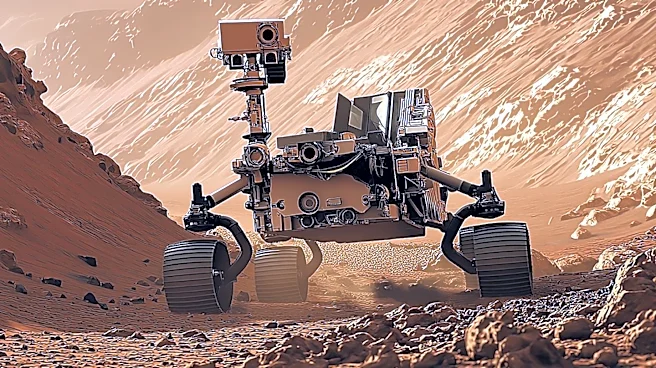
This breakthrough has significant implications for various U.S. industries reliant on AI-generated content and simulations. In the entertainment sector, particularly video game development, it could lead to more immersive and controllable virtual worlds, enhancing user experience and opening new creative possibilities for game designers. For virtual production, a growing field in filmmaking, directors could achieve more precise camera movements within AI-generated sets, streamlining production workflows and reducing costs. The most critical impact might be in robotics and autonomous systems. By creating more accurate and responsive simulated environments, this training fix can accelerate the development and testing of robots, allowing them to be trained in complex scenarios that are too dangerous or impractical in the real world. This could lead to faster deployment of advanced robotics in manufacturing, logistics, and other critical sectors, ultimately boosting efficiency and safety. The ability to generate more controllable and realistic virtual environments also has potential applications in defense and scientific research, where high-fidelity simulations are paramount.
What's Next?
The research team has posted their study as a preprint, indicating that the method is now available for review and potential adoption by the wider AI research community. The next steps will likely involve further validation and integration of Context-Matched Distillation into commercial AI development pipelines, particularly those focused on video generation and interactive simulations. Companies like NVIDIA, which collaborated on the research, may incorporate this method into their AI tools and platforms, making it accessible to developers and creators. We can anticipate seeing this technology applied in upcoming video games, virtual reality experiences, and advanced robotics training programs. Further research may explore extending this method to even more complex AI generation tasks and integrating it with other emerging AI techniques. The long-term goal is to move towards AI systems capable of generating entire, interactive 'worlds' that users can navigate and modify in real-time, which would represent a significant leap in AI's creative and functional capabilities.
Beyond the Headlines
Beyond the immediate applications, this research touches upon fundamental challenges in AI training and the pursuit of truly intelligent systems. The 'teacher-student context mismatch' highlights a critical flaw in how AI models learn, where the training environment doesn't accurately reflect real-world deployment conditions. By addressing this, the researchers are pushing AI development towards more robust and adaptable models. This shift could lead to AI systems that are not only more responsive but also more capable of understanding and reacting to dynamic, unpredictable environments, moving beyond static pattern recognition. Ethically, as AI-generated worlds become more indistinguishable from reality and more responsive to user input, questions about the nature of reality, digital ownership, and the potential for immersive but potentially manipulative experiences will become more prominent. Culturally, the ability to generate entire interactive worlds on demand could revolutionize storytelling, education, and even social interaction, blurring the lines between creator and participant in unprecedented ways. This development underscores the ongoing evolution of AI from a tool for automation to a partner in creation and interaction.