





What's Happening?
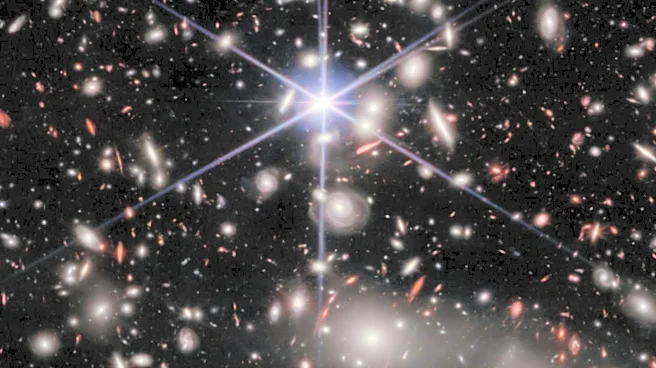
Astronomers have identified a colossal structure in the distant universe, named 'The Big Ring', which is challenging existing cosmological models. This discovery was led by Alexia Lopez from the University of Central Lancashire and presented at the American
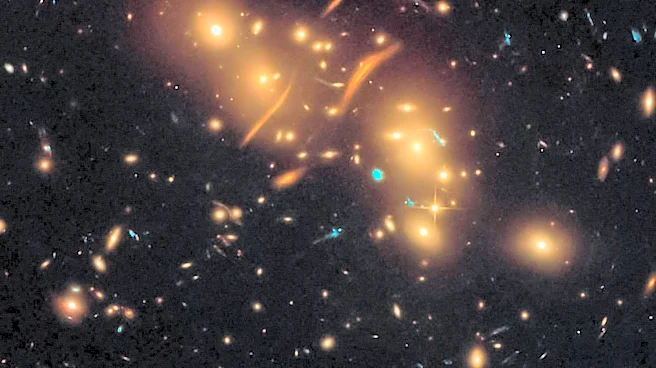
Astronomical Society meeting in 2024. The Big Ring, a nearly perfect circle of galaxies spanning 1.3 billion light-years, was detected in light that has traveled 6.9 billion years to reach Earth. This structure, along with a previously discovered Giant Arc, suggests that the standard model of cosmology may need revision. These structures are much larger than the theoretical size limit of 1.2 billion light-years, posing questions about the distribution of matter in the universe.
Why It's Important?
The discovery of The Big Ring and the Giant Arc has significant implications for our understanding of the universe's evolution. These structures defy the Cosmological Principle, which posits that the universe should appear uniform on a large scale. The existence of such massive formations suggests that our current cosmological models may be incomplete or require adjustments. This could lead to new theories about the universe's structure and the forces shaping it. The findings also open up possibilities for alternative models, such as Roger Penrose's conformal cyclic cosmology, which proposes endless cycles of Big Bang expansions.
What's Next?
Future research will focus on identifying more such structures to understand their nature and implications better. Scientists will continue to explore whether these formations are chance arrangements or indicative of unknown cosmic phenomena. Theoretical models, including those involving cosmic strings, will be further examined to explain these observations. The ongoing study of these structures could lead to breakthroughs in cosmology and a deeper understanding of the universe's fundamental principles.
Beyond the Headlines
The discovery of The Big Ring and the Giant Arc raises questions about the fundamental assumptions of cosmology. If these structures are not anomalies, they could indicate new physics or unknown forces at play in the universe. This challenges the notion of a homogeneous universe and could lead to a paradigm shift in how we perceive cosmic evolution. The findings also highlight the importance of continued astronomical observations and theoretical advancements to unravel the universe's mysteries.