






What's Happening?
Prime Minister Narendra Modi has welcomed several Union Cabinet decisions, emphasizing their potential to accelerate justice delivery, strengthen energy security, and build domestic capabilities in India. Among the key approvals is the continuation of
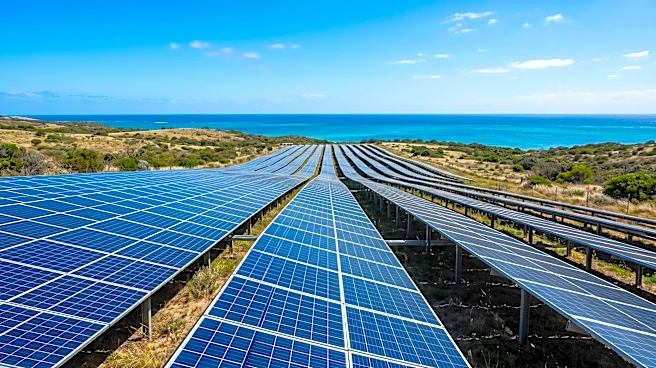
the Centrally Sponsored Scheme for Fast Track Special Courts, including exclusive POCSO courts, for five years from April 1, 2026. This scheme, with a total outlay of Rs 3,788.04 crore, aims to ensure faster justice. Additionally, the Cabinet approved a Rs 14,500 crore Viability Gap Funding Scheme to develop 92 GWh of grid-scale energy storage capacity, which is expected to attract nearly Rs 1 lakh crore in investment. This energy storage scheme, running until 2030–31, will support pumped hydro storage, battery energy storage, and emerging storage technologies, with a minimum domestic content requirement of 40 percent for battery projects. The Viksit Bharat Initiative for Statistical Transformation, Analytics & Research (VISTAR) was also approved to modernize India’s statistical system, and a scheme to strengthen domestic processing of critical minerals like lithium, nickel, and cobalt was greenlit.
Why It's Important?
These Cabinet decisions are significant for India's strategic development across multiple sectors. The continuation of fast-track courts is crucial for addressing the backlog of cases involving women and children, thereby enhancing social justice and protection for vulnerable populations. The substantial investment in energy storage capacity is vital for India's energy security, enabling greater integration of renewable energy sources and improving power reliability. This move will reduce India's reliance on imported energy and foster domestic manufacturing capabilities in the energy sector. Furthermore, the VISTAR scheme aims to improve data-driven decision-making and policy formulation, which is fundamental for effective governance and economic planning. The focus on critical mineral processing is essential for India to reduce its dependence on imported refined materials, supporting the growth of electric vehicles, batteries, electronics, and defense industries, and building self-reliance in future technologies.
What's Next?
The Fast Track Special Courts scheme will continue for five years from April 1, 2026, with ongoing efforts to expedite trials and reduce pendency. The Viability Gap Funding Scheme for energy storage will run until 2030–31, with a focus on developing 92 GWh capacity and attracting significant private investment. The implementation of the VISTAR scheme will involve modernizing India’s statistical system through technology and AI, with an emphasis on detailed local-level data. The scheme for critical mineral processing will focus on establishing new processing plants, providing capital subsidies, and strengthening domestic supply chains to build capabilities in essential raw materials for advanced technologies. These initiatives are expected to drive economic growth, enhance national security, and improve the quality of life for citizens over the coming years.
Beyond the Headlines
These comprehensive policy decisions reflect India's strategic vision for a self-reliant and technologically advanced future. The interconnectedness of these initiatives is noteworthy: robust energy storage supports the transition to renewable energy, which in turn reduces reliance on fossil fuels and contributes to climate goals. Domestic processing of critical minerals is foundational for the growth of advanced manufacturing sectors, including electric vehicles and defense, aligning with the 'Make in India' initiative. Improved statistical systems (VISTAR) will provide the necessary data infrastructure to monitor and evaluate the progress of these ambitious projects, ensuring evidence-based policy adjustments. Collectively, these decisions aim to position India as a leader in sustainable development, technological innovation, and social justice on the global stage.