
What's Happening?
Voyager 1, launched by NASA in 1977, continues to communicate with Earth from a distance of 25.43 billion kilometers. The spacecraft, now in interstellar space, sends data back to Earth using less than
200 watts of power. Signals from Voyager 1 take 23 hours and 33 minutes to reach Earth, highlighting the vast distance it has traveled. The spacecraft operates on radioisotope thermoelectric generators, which use decaying plutonium to generate electricity. Despite its age and the challenges of maintaining such an old spacecraft, NASA engineers continue to manage Voyager 1's systems to keep it operational.
Why It's Important?
Voyager 1's continued operation is a testament to the durability and ingenuity of NASA's engineering. It provides valuable data about the outer reaches of the solar system and interstellar space, contributing to our understanding of the universe. The mission demonstrates the potential for long-term space exploration and the importance of maintaining communication with distant spacecraft. Voyager 1 also serves as a symbol of human curiosity and the desire to explore beyond our planet.
What's Next?
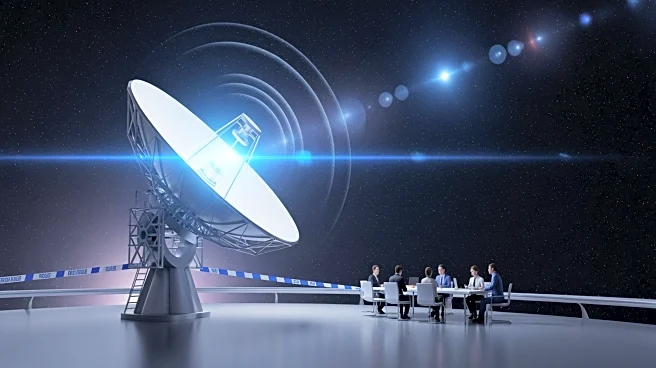
As Voyager 1 continues its journey, it will eventually reach a point where its power supply is insufficient to operate its instruments. However, it will remain a silent ambassador of Earth, carrying the Golden Record, a time capsule of human culture, into the cosmos. NASA will continue to monitor and manage the spacecraft as long as possible, using the Deep Space Network to receive its faint signals.