
What's Happening?
The European Union's policy of layering additional duties of up to 35% on electric vehicles (EVs) assembled in China, on top of its standard 10% import duty, has not effectively curbed the advance of Chinese
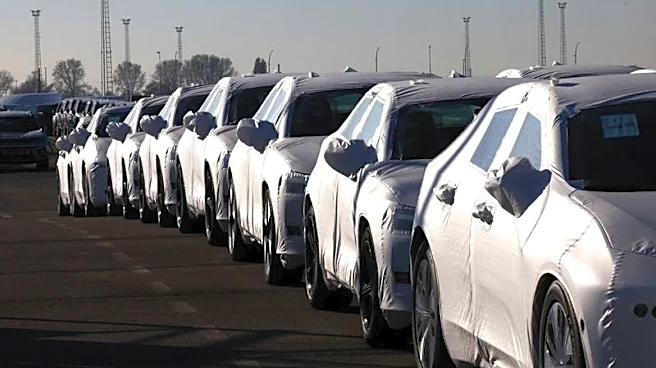
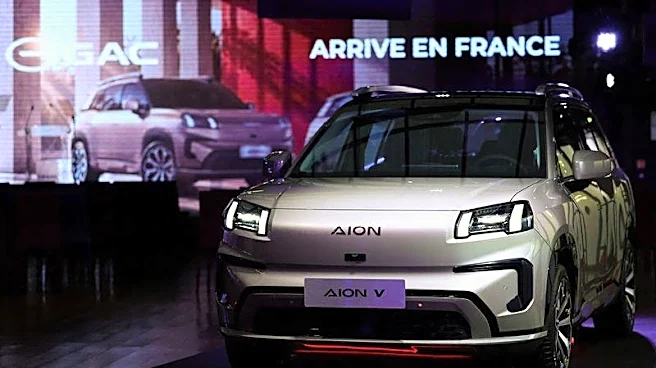
carmakers. While the share of Chinese-built EVs in the EU market fell from 22% in 2024 to 17% by Q1 2026, this decline was primarily due to Western brands, including European manufacturers and Tesla, moving their production out of China. Chinese carmakers, conversely, now account for over half of all Chinese-built EV imports into the EU, a near-inversion of the policy's original intent. Even with tariffs, cars built in China remain approximately 21% cheaper than comparable European EVs, indicating that the tariffs have narrowed the price gap but not closed it.
Why It's Important?
This development highlights the complexities and often unintended consequences of tariff policies in a globalized economy. For the U.S., it serves as a case study in how protectionist measures, while aiming to safeguard domestic industries, can lead to strategic adjustments by foreign competitors rather than outright suppression. The shift of production by Western brands out of China, and the continued dominance of Chinese carmakers in EU imports, suggests that tariffs on final assembly may not be sufficient to address underlying cost advantages, such as those in battery production. This could influence future U.S. trade policy discussions, particularly concerning critical sectors like EVs, by emphasizing the need for comprehensive strategies that consider the entire supply chain and potential for circumvention.
What's Next?
The EU's experience suggests that future policy considerations may need to extend beyond tariffs on finished products to address components like batteries, which represent the largest single cost of an EV. Transport & Environment calculates that a 20% tariff on Chinese batteries could significantly boost European battery makers without drastically increasing EV prices. Additionally, the emergence of deals where Chinese-built models are exempted from duties in exchange for minimum prices and volume quotas indicates a potential shift towards managed competition rather than outright trade barriers. This could lead to more nuanced trade agreements and industrial policies aimed at fostering domestic competitiveness across the entire value chain, rather than solely relying on import duties.
Beyond the Headlines
The failure of EU tariffs to significantly deter Chinese EV manufacturers underscores a broader geopolitical and economic struggle for technological and industrial leadership. China's cost advantage, rooted in subsidies, scale, and control over battery production, allows its companies to adapt to tariffs by relocating assembly or focusing on components not subject to duties. This situation challenges the traditional understanding of 'made in China' as a simple geographical indicator, revealing it as a complex web of global production and ownership. For the U.S., this implies that effective competition with China in advanced manufacturing sectors like EVs will require not just tariffs, but also substantial domestic investment in research, development, and manufacturing capabilities, particularly in critical areas like battery technology, to build genuine competitive advantages.