






What's Happening?
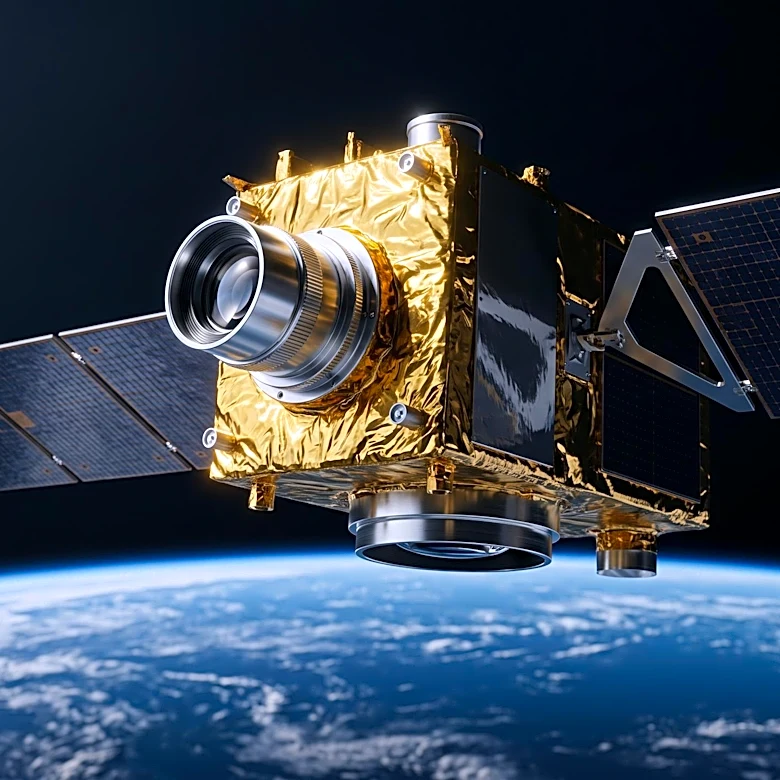
Researchers at the University of York have successfully designed, built, and tested a continuous variable (CV) payload transmitter for downlink-based quantum key distribution (QKD) from a CubeSat. This development is part of the Satellite Platform for Optical
Quantum Communications (SPOQC) mission by the Quantum Communications Hub, UK, which launched in March 2026. The CV-QKD scheme enables two parties to share a secret key over long distances, and this mission extends these capabilities to a cost-effective CubeSat platform. The system integrates both optical and electronic subsystems within a roughly ¾U CubeSat unit, adhering to strict size, weight, and power constraints. It employs amplitude and phase modulators to generate Gaussian modulated coherent states, a method for encoding information onto the quantum signal, and includes a quantum random number generator.
Why It's Important?
This advancement is crucial for establishing worldwide quantum networks, as it addresses the challenge of extending secure quantum links over continental distances, which is often limited by exponential signal loss in terrestrial fibers. By utilizing free-space links from Low Earth Orbit satellites, the SPOQC mission aims to enable long-distance key distribution between ground stations separated by thousands of kilometers. This approach offers a more cost-effective and scalable solution compared to larger, more complex space-based QKD missions. The successful integration of a CV-QKD transmitter into a CubeSat demonstrates the feasibility of deploying quantum technologies on resource-limited satellite platforms, potentially broadening access to information-theoretic security for various applications, including government communications, financial transactions, and critical infrastructure protection.
What's Next?
The successful demonstration of this compact CV-QKD transmitter lays the groundwork for future missions aimed at global quantum key distribution and secure satellite-to-ground links. The design provides a practical pathway toward spaceborne CV quantum communications and scalable global quantum networks. Researchers anticipate further optimization of future CV payloads through the use of smaller form factor components, migration to a low-local oscillator-based scheme, or the integration of photonic integrated chips. These advancements could significantly reduce the size, weight, and power consumption of such systems, making them even more accessible and deployable. Continued testing and validation in orbit will be essential to refine the technology and expand its capabilities for broader implementation.
Beyond the Headlines
The development of CubeSat-based quantum communication systems signifies a paradigm shift in how secure information can be transmitted globally. This technology has the potential to democratize access to quantum-secure communications, moving beyond the exclusive domain of large national space agencies. It raises questions about the future of internet security, national defense, and international data privacy, as quantum-resistant encryption becomes more widespread. The ability to deploy such advanced technology on small, cost-effective platforms could also spur innovation in other areas of space technology, fostering a new era of distributed and resilient space-based infrastructure. This could lead to a more secure and interconnected world, but also presents new challenges in terms of regulatory frameworks and international cooperation for managing quantum communication networks.