







What's Happening?
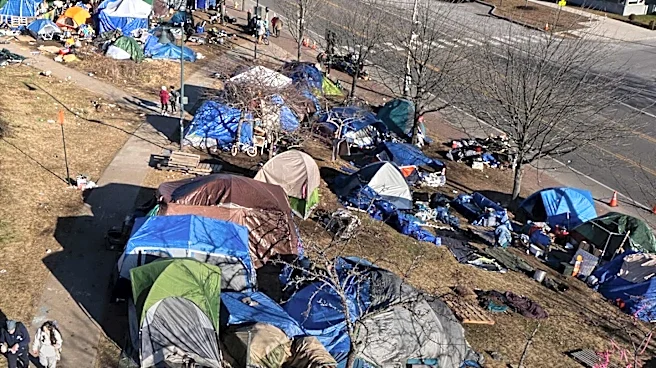
Middlebury, Vermont, officials have implemented what some are calling 'anti-homelessness landscaping' by placing large, uneven rocks and a chain-link fence under the town's Cross Street Bridge. This area was previously a frequent resting place and encampment
for unhoused residents. Town Manager Mark Pruhenski stated the decision was made due to public safety concerns and complaints from adjacent businesses, describing the area as a 'difficult area to manage' with a 'revolving door of tents.' While officials provided notice and attempted to connect residents with services, the move has drawn conflicted reactions from local service providers. Josh Simon, a former unhoused resident who used the spot, acknowledged the town's reasoning but noted the move was upsetting for others. Service providers like Jeanne Montross of HOPE and Susan Whitmore of the John Graham Shelter highlight that local shelters are severely overflowing, leaving unhoused individuals with few alternatives.
Why It's Important?
This situation in Middlebury is important because it exemplifies the complex and often contentious challenges faced by municipalities across the U.S. in addressing homelessness, particularly in rural areas. The implementation of 'anti-homelessness landscaping' reflects a common approach by local governments to deter encampments, but it also highlights a critical gap in available resources and solutions for unhoused populations. The overflowing shelters and long waitlists in Middlebury and surrounding areas underscore the systemic nature of the homelessness crisis, which cannot be resolved solely through deterrent measures. This approach can lead to the dispersal of unhoused individuals into more remote and less visible locations, making it harder for service providers to connect them with essential support, as noted by State Rep. Jubilee McGill. The debate in Middlebury reflects a broader national struggle to balance public safety and business concerns with the humanitarian needs of vulnerable populations.
What's Next?
As cold weather approaches, the displacement of unhoused individuals from the Cross Street Bridge area in Middlebury raises immediate concerns about their safety and well-being. Local service providers anticipate increased difficulties in reaching and assisting these dispersed populations. The ongoing debates in Montpelier over the state's approach to homelessness, including recent changes to emergency housing programs, will be crucial in determining the availability of resources for municipalities like Middlebury. Without adequate state and federal funding, local governments will continue to struggle with finding sustainable solutions. The Middlebury Selectboard, as indicated by Chair Andy Hooper, faces a tough question regarding the balance between managing public spaces and supporting vulnerable residents. This situation will likely continue to spark discussions about more compassionate and effective strategies for addressing homelessness beyond simply moving encampments.
Beyond the Headlines
The 'anti-homelessness landscaping' in Middlebury brings to light the ethical dimensions of urban planning and public space management. It raises questions about whether such measures, often termed 'hostile architecture,' genuinely solve the problem of homelessness or merely displace it, making the issue less visible but potentially more dangerous for those affected. The narrative also touches upon the societal perception of unhoused individuals, where their presence can be seen as a nuisance rather than a symptom of broader socio-economic failures. The difficulty in dealing with homelessness at the municipal level, as highlighted by Andy Hooper, underscores the need for comprehensive, multi-level government strategies that address the root causes of homelessness, such as lack of affordable housing, mental health services, and substance abuse treatment. This incident serves as a microcosm of the larger national debate on how communities should respond to and support their most vulnerable members.