








What's Happening?
A two-decade-long experiment, known as the Jena Experiment, has revealed that diverse plant communities significantly outperform monocultures in agricultural systems. The study, which monitored 82 grassland plots with varying species counts, found that plots with 16
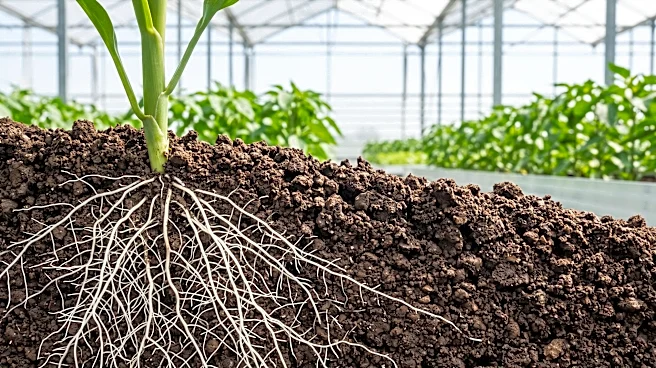
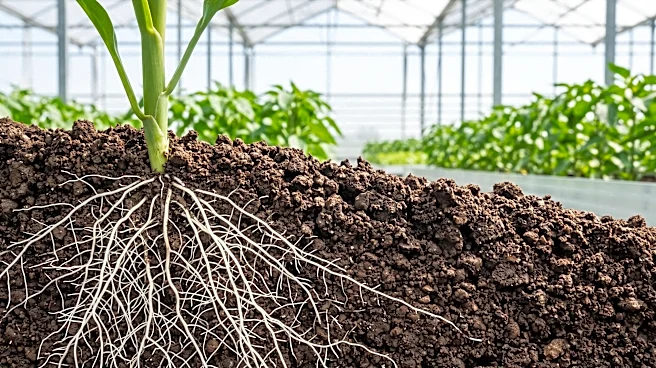
or more species exhibited triple the soil carbon storage, built topsoil 2.7 times faster, supported 45% more pollinators, and were 50% more drought-resistant compared to monocultures. Beyond these metrics, the research observed sophisticated sharing networks developing among plant species, indicating active cooperation rather than mere coexistence. This challenges the traditional agricultural assumption that plant performance can be predicted based on individual traits, as the most productive combinations were those that had time to adapt to each other. The experiment also showed that below-ground, these diverse communities fostered extensive mycorrhizal connections and unprecedented microbial diversity, essentially creating new ecosystems. The benefits of diversity followed a clear timeline, with maximum ecosystem services achieved after eight years, including 180% higher carbon sequestration and 70% better nutrient retention.
Why It's Important?
The findings from the Jena Experiment have profound implications for U.S. agriculture, which has historically relied heavily on monoculture farming. This research suggests that current agricultural practices may be systematically underestimating the potential of diverse plant communities by focusing on short-term evaluations. Adopting more diverse cropping systems could lead to significant improvements in soil health, reduced reliance on external inputs like fertilizers and pesticides, and enhanced resilience against environmental stressors such as drought. Farmers stand to gain from more stable yields and improved long-term productivity, while the environment benefits from increased carbon sequestration and biodiversity. This shift could influence agricultural policy, encouraging practices that promote ecological complexity rather than simplification. The economic impact could include lower input costs for farmers and a more sustainable food supply chain, potentially reducing the environmental footprint of agricultural production across the nation.
What's Next?
The insights from the Jena Experiment could drive a re-evaluation of agricultural research and development priorities in the U.S. Future steps may involve increased funding for studies on polyculture systems and the development of practical guidelines for farmers to implement diverse planting strategies. Agricultural extension services might begin to emphasize the long-term benefits of biodiversity, offering training and resources for transitioning away from monocultures. Policy makers could explore incentives for farmers who adopt these more ecologically complex approaches, potentially through subsidies or conservation programs. Furthermore, seed companies and agricultural technology firms may start to focus on developing diverse seed mixes and tools that support complex agroecosystems. The scientific community will likely continue to investigate the mechanisms behind plant cooperation and soil biodiversity to further optimize these sustainable farming methods.
Beyond the Headlines
The Jena Experiment's findings extend beyond immediate agricultural practices, touching upon broader ethical and philosophical considerations regarding humanity's relationship with nature. The study underscores the value of ecological complexity and the limitations of reductionist approaches in understanding natural systems. It highlights a paradigm shift from viewing nature as a resource to be managed for maximum individual output, to recognizing it as an interconnected system where cooperation and diversity drive resilience and productivity. This could foster a deeper appreciation for biodiversity not just in agriculture, but in broader environmental conservation efforts. Legally, it might influence land-use policies and environmental regulations to prioritize ecosystem health and diversity. Culturally, it could encourage a return to more holistic farming traditions and a greater public demand for sustainably produced food, fostering a more harmonious coexistence with natural ecosystems.