
What's Happening?
The Hubble Space Telescope has provided a detailed view of the Crab Nebula's expansion over a 25-year period. The nebula, a remnant of a supernova explosion that occurred nearly a millennium ago, has been observed to be in motion, continuing to expand.
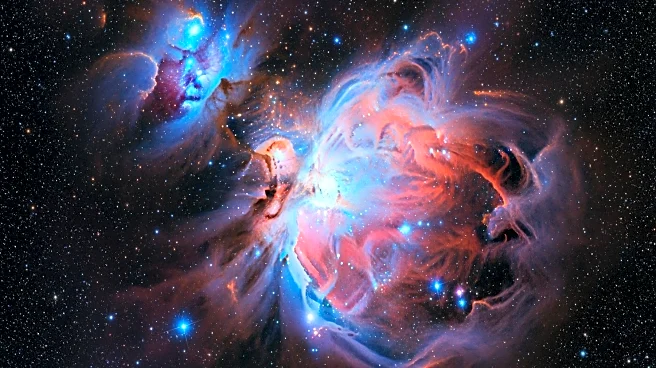
This observation was made possible by comparing images taken by Hubble in 1999/2000 and 2024. The Crab Nebula, located 6,500 light-years away in the constellation Taurus, is powered by a pulsar at its center. This pulsar, a rapidly rotating neutron star, drives the nebula's expansion by propelling charged particles outward with its powerful magnetic field. The Hubble's Wide Field Camera 3, installed in 2009, has allowed scientists to observe the nebula's intricate filaments and measure their outward movement. The images reveal the nebula's glowing filaments, with blue regions indicating the hottest, lowest-density gas, and yellow and red tones showing energized sulfur and oxygen.
Why It's Important?
The observations of the Crab Nebula's expansion provide significant insights into cosmic phenomena and the life cycle of supernova remnants. The ability to track changes in such distant objects over time enhances our understanding of the universe's dynamics. The Hubble Space Telescope's longevity has been crucial in capturing these changes, offering a unique opportunity to study the evolution of cosmic structures. This research not only contributes to the field of astronomy but also aids in the development of future space observation technologies. The findings have implications for understanding the behavior of pulsars and their role in the expansion of nebulae, which can influence theories about the formation and evolution of galaxies.
What's Next?
Future observations with the Hubble and other telescopes, such as the James Webb Space Telescope, will continue to monitor the Crab Nebula and other similar cosmic structures. These observations will help refine models of supernova remnants and the mechanisms driving their expansion. The ongoing study of the Crab Nebula will also contribute to the broader understanding of the universe's history and the processes that shape it. As technology advances, astronomers will be able to capture even more detailed images and data, further enhancing our knowledge of the cosmos.
Beyond the Headlines
The study of the Crab Nebula's expansion highlights the importance of long-term space observation projects. The Hubble Space Telescope's ability to provide consistent data over decades underscores the value of sustained investment in space exploration. This research also raises questions about the future of space telescopes and the need for continued innovation in this field. The collaboration between different telescopes, such as Hubble and the James Webb Space Telescope, exemplifies the potential for combined efforts to yield comprehensive insights into cosmic phenomena.