



What's Happening?
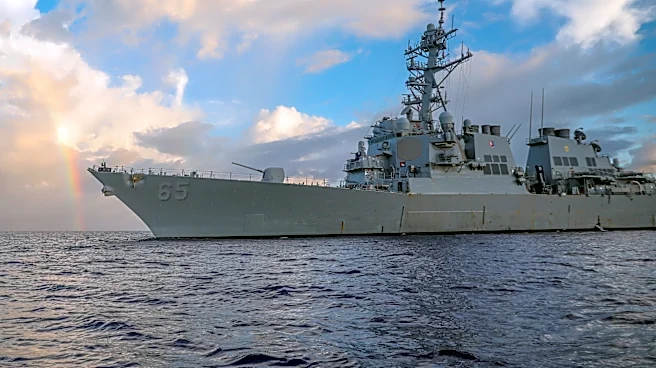
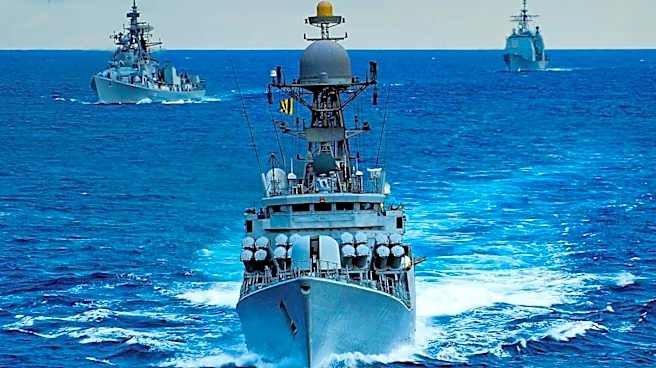
A U.S. guided-missile destroyer, the USS Benfold, suffered a four-day power loss last month while operating in the South China Sea. The incident, caused by an engineering casualty involving its generators, necessitated towing the warship to Subic Bay
in the Philippines for repairs. Power was restored two days after its arrival in Subic Bay. During the outage, essential services such as galley operations, toilets, air conditioning, and potable water were disrupted. The guided-missile cruiser USS Robert Smalls provided meals to the crew, and the strike group supported the destroyer throughout the casualty. No injuries to the crew were reported. The Navy is currently investigating the cause of the failure and has not publicly detailed the impact on the Benfold's propulsion, navigation, communications, sensors, weapons systems, or emergency power.
Why It's Important?
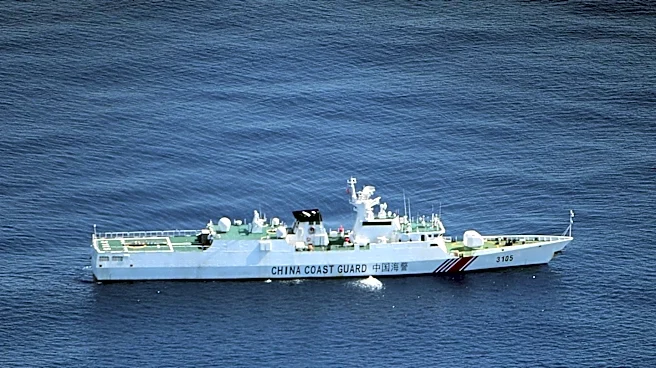
This incident highlights potential vulnerabilities in U.S. naval operations within the strategically vital South China Sea, a region where the U.S. Navy frequently conducts missions with allies and partners amidst China's expansive territorial claims. The power loss on an Arleigh Burke-class destroyer, a key component of the U.S. fleet, raises questions about operational readiness and the resilience of naval assets in contested waters. The reliance on support from the USS George Washington Carrier Strike Group, especially as it prepared for deployment to the Middle East, underscores the interconnectedness and potential strain on naval resources. Such an event could be perceived as a weakness by geopolitical rivals, potentially influencing regional dynamics and the perception of U.S. naval power in the Indo-Pacific.
What's Next?
The U.S. Navy is conducting an investigation into the cause of the engineering casualty on the USS Benfold. The findings of this investigation will be crucial in determining whether the incident was an isolated event or indicative of broader maintenance or design issues within the destroyer fleet. It remains unclear if the Benfold will rejoin the USS George Washington Carrier Strike Group for its Middle East deployment after regaining power. The Navy will likely assess whether this casualty necessitates maintenance checks or other actions across its destroyer fleet to prevent similar occurrences. The incident may also prompt a review of contingency plans for power loss scenarios in critical operational areas, particularly given the strategic importance of the South China Sea.
Beyond the Headlines
Beyond the immediate operational concerns, this incident could have broader implications for U.S. defense strategy and procurement. A significant power loss on a modern warship in a contested area might lead to increased scrutiny of naval maintenance budgets, training protocols, and the reliability of critical systems. It could also fuel debates about the optimal deployment of naval assets and the balance between commitments in different global theaters, such as the Indo-Pacific and the Middle East. The incident may also influence future naval design and engineering considerations, emphasizing redundancy and resilience in power generation and distribution systems to ensure continuous operational capability in high-stakes environments.