




What's Happening?
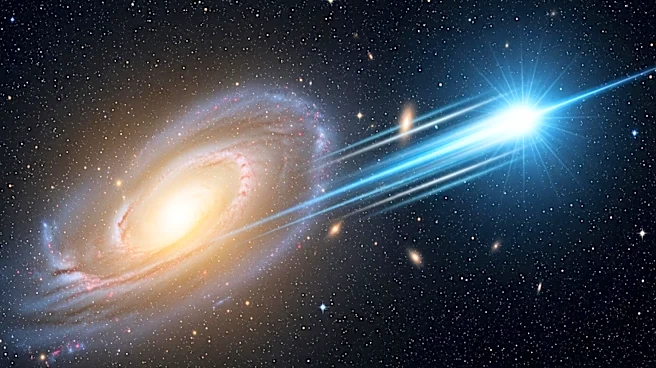
Chinese astronomers have discovered a hypervelocity star, DESI-HVS1, which is believed to have been ejected from the center of the Milky Way. This star, identified using data from the Dark Energy Spectroscopic Instrument (DESI) and ESA's Gaia satellite,
is an old, low-mass, metal-poor F-type star. It is located approximately 12,300 light years away and has a velocity of about 523 km/s, suggesting it is moving away from the galactic disk. The star's properties and trajectory indicate it was likely ejected by the supermassive black hole at the galaxy's center through the Hills mechanism.
Why It's Important?
The discovery of DESI-HVS1 is significant as it expands the known population of hypervelocity stars ejected from the galactic center. These stars provide valuable insights into the dynamics of the Milky Way and the interactions between stars and the supermassive black hole at its center. Understanding hypervelocity stars can help astronomers study the gravitational forces and potential energy sources within galaxies. This research also highlights the capabilities of modern astronomical instruments in identifying and analyzing distant celestial objects, contributing to the broader understanding of galactic evolution and structure.
What's Next?
Further studies are expected to confirm the origin of DESI-HVS1 and explore its trajectory and properties in more detail. Continued observations using DESI and Gaia, along with other telescopes, will help refine models of hypervelocity star ejection and improve understanding of the Milky Way's dynamics. This research may also lead to the discovery of additional hypervelocity stars, providing more data to study the interactions between stars and supermassive black holes. Such findings could have implications for theories on galaxy formation and the behavior of stars in extreme gravitational environments.