






What's Happening?
NASA's Artemis II mission, which sent four astronauts around the Moon, caused significant temporary disturbances in Earth's ionosphere. A new study, led by scientists at National Cheng Kung University in Taiwan, indicates that the rocket temporarily stripped
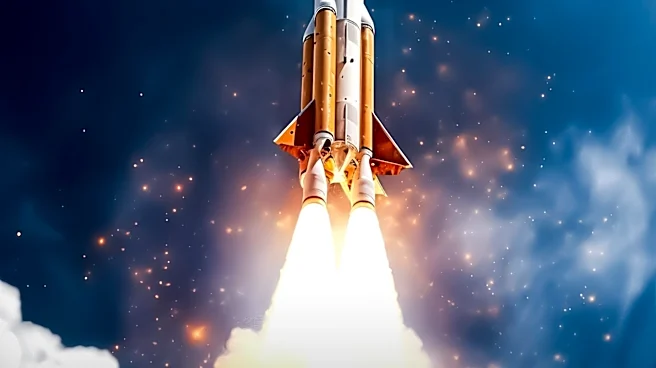
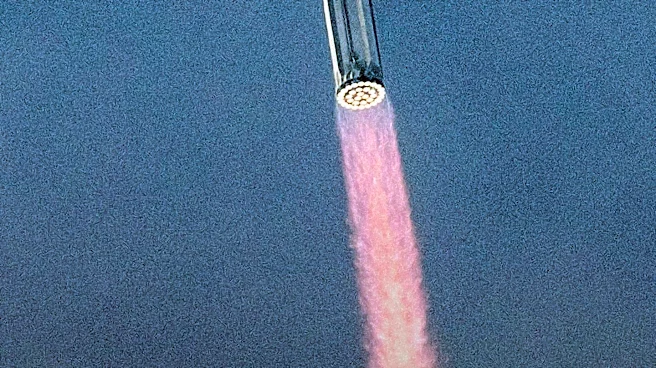
electrons from the upper atmosphere, creating two disturbances each stretching approximately 3,100 miles (5,000 kilometers) across the Americas. These effects were up to 10 times more intense than those observed from SpaceX Starship test flights. The first disturbance occurred during the Space Launch System core stage's ascent, while the second, more prominent one, happened over an hour after liftoff when the upper stage fired its engine twice directly within the ionosphere. This exhaust chemically reacted with the charged gas, depleting electrons over a wide area. The research utilized high-precision ground-based GPS receivers, typically used for tracking tectonic plate motion, to map these electron changes.
Why It's Important?
The ionospheric disturbances caused by the Artemis II launch are significant because they can lead to GPS positioning errors of several meters. While such errors may not impact everyday phone navigation, they pose a considerable risk for systems that rely on precise satellite positioning, such as autonomous cars, drones, and precision agriculture equipment. A positioning error of a few meters could cause an autonomous vehicle to change lanes or disrupt drone navigation. Although most self-driving systems integrate multiple sensors (cameras, radar, lidar, inertial sensors) to mitigate GPS errors, the sudden and widespread nature of these ionospheric disruptions could challenge backup systems. This highlights a growing concern as launch frequency increases and rockets become larger, potentially leading to more frequent and intense human-made space weather events.
What's Next?
Researchers are continuing to study the full implications of these ionospheric disturbances. Future work will focus on determining how long these electron depletions lasted at each location, whether they caused measurable errors in commercial receivers, and how a launch's trajectory and burn altitude influence the size of the effect. As more heavy rockets are launched for missions like Artemis III, Starship flights, and future Mars missions, the space weather effects from these events are expected to become more significant. For operators of precision agriculture, survey crews, commercial drone pilots, and companies testing automated vehicles, it will become increasingly important to treat launch windows as minor space weather events, requiring them to check launch schedules, maintain sensor backups, and avoid sole reliance on satellite positioning for safety-critical tasks.
Beyond the Headlines
This discovery adds a new dimension to the understanding of human impact on Earth's atmosphere and its potential consequences for advanced technologies. Beyond natural phenomena like solar storms, rocket launches are now recognized as a source of temporary, yet significant, ionospheric disruption. This raises questions about the long-term cumulative effects of increasing space traffic on the ionosphere and the reliability of GPS-dependent infrastructure. The findings underscore the need for robust and resilient navigation systems that can account for both natural and human-induced space weather. It also prompts a broader discussion on the environmental footprint of space exploration, extending beyond traditional concerns about orbital debris to include atmospheric alterations that could affect critical ground-based operations and emerging autonomous technologies.