


What's Happening?
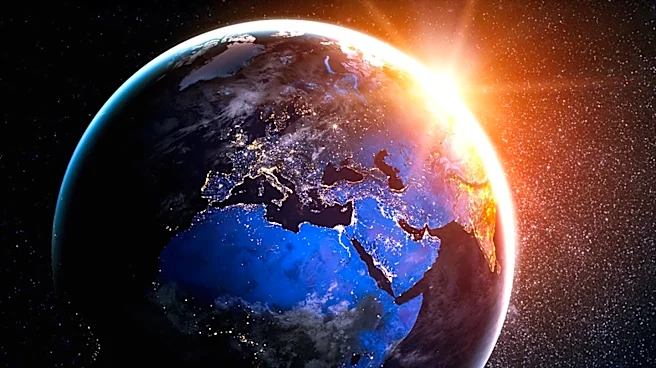
The equinox is a precise astronomical event occurring twice a year, in March and September, when the center of the sun crosses Earth's equatorial plane. This moment signifies the beginning of astronomical spring in the Northern Hemisphere during the March equinox and the start
of astronomical autumn in the Northern Hemisphere (and spring in the Southern Hemisphere) during the September equinox. While commonly associated with equal day and night, the equinox is more accurately a turning point in the Earth-sun geometry, marking the transition in seasonal patterns. The term 'equinox' derives from Latin words meaning 'equal night,' though due to factors like the sun being a disk and atmospheric light bending, day and night are not perfectly equal on these specific dates. The exact dates when day and night are precisely 12 hours each, known as the equilux, vary by latitude.
Why It's Important?
The equinox holds significant importance as a natural marker of seasonal change, influencing various aspects of human life and historical practices. For agricultural societies, observing the sun's movement and the equinoxes provided crucial information for planting and harvesting cycles, demonstrating humanity's early reliance on astronomical skills for survival and planning. Beyond agriculture, the equinox has inspired cultural traditions and festivals across diverse societies, such as Nowruz, a spring celebration rooted in astronomical calculation and associated with renewal. The subtle shifts in daylight and the sun's angle, though not the equinox itself, are human-scale consequences of Earth's tilt and orbit, impacting daily routines, natural environments, and even architectural alignments in ancient structures like Loughcrew in Ireland and Chichén Itzá in Mexico, which demonstrate sophisticated understanding of these celestial events.
What's Next?
Following an equinox, the Earth continues its orbit around the sun, leading to a gradual shift in the length of day and night. After the March equinox, the Northern Hemisphere experiences progressively longer days, moving towards the summer solstice, while the September equinox ushers in shorter days and longer nights, leading to the winter solstice. This ongoing celestial mechanics will continue to dictate seasonal changes, influencing weather patterns, agricultural cycles, and human activities. The recognition of these transitions will persist through various cultural observances and personal experiences, as individuals continue to notice the changing light and the progression of the year. The scientific understanding of the equinox will remain a cornerstone of astronomy, providing a precise framework for understanding Earth's relationship with the sun.
Beyond the Headlines
The concept of the equinox extends beyond its scientific definition, touching upon deeper cultural and philosophical dimensions. Historically, the equinoxes have served as powerful symbols of balance, transition, and renewal across numerous civilizations. While the modern understanding emphasizes the precise astronomical moment, ancient cultures often interpreted these events through the lens of their worldviews, integrating them into religious practices, calendar systems, and monumental architecture. The enduring human impulse to mark these celestial turning points highlights a fundamental connection between humanity and the cosmos. This connection fosters a sense of continuity with past generations who also observed and interpreted these same celestial phenomena, underscoring the universal human experience of living on a tilted planet and adapting to its rhythmic changes. The equinox, therefore, is not just an astronomical fact but a recurring narrative in the human story.