


What's Happening?
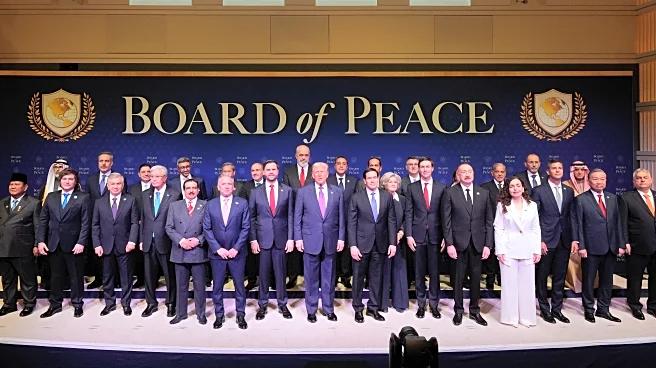
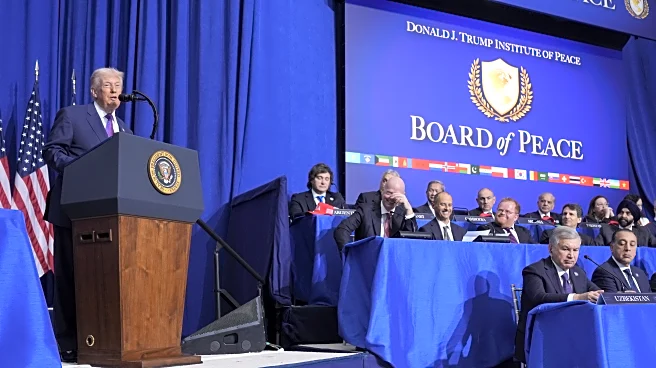
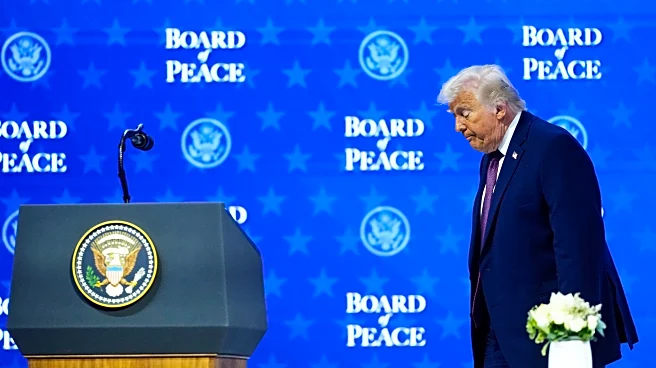
President Trump has convened the inaugural meeting of his Board of Peace, which includes representatives from over 40 countries and observers from additional nations. The meeting, held in Washington, focuses on the reconstruction of Gaza and the establishment
of an international stabilization force. President Trump announced a U.S. pledge of $10 billion to the Board of Peace, with other countries pledging a combined $7 billion for Gaza relief. The initiative aims to create a stabilization force comprising 12,000 police and 20,000 soldiers, with contributions from countries like Indonesia, Morocco, and Kazakhstan. The Board of Peace is seen as a potential rival to the United Nations, with Trump expressing a desire for it to oversee and ensure the effectiveness of the U.N. The initiative has sparked skepticism among some U.S. allies and international observers.
Why It's Important?
The establishment of the Board of Peace by President Trump represents a significant shift in international conflict resolution efforts, potentially challenging the role of the United Nations. The U.S. pledge of $10 billion underscores a substantial financial commitment to global peace initiatives, particularly in the Middle East. This move could influence U.S. foreign policy and international relations, as it seeks to position the Board of Peace as a key player in global conflict resolution. The involvement of numerous countries in the initiative highlights a broad international interest, although the absence of major allies like the U.K., France, and Canada raises questions about the board's acceptance and legitimacy. The initiative's success or failure could have lasting implications for U.S. diplomatic influence and the future of international peacekeeping efforts.
What's Next?
The Board of Peace will continue to develop its plans for Gaza reconstruction and the deployment of the international stabilization force. Upcoming discussions will focus on the logistics of troop contributions and the training of local police forces by neighboring countries like Egypt and Jordan. The initiative's progress will be closely monitored by international stakeholders, including the United Nations, which may face pressure to adapt its role in global peace efforts. The Board of Peace's activities and its relationship with the U.N. will likely be subjects of ongoing diplomatic negotiations and scrutiny. Additionally, the initiative's impact on U.S. domestic politics, particularly in the context of upcoming elections, will be an area of interest as President Trump seeks to leverage the board's achievements as a political asset.
Beyond the Headlines
The creation of the Board of Peace raises questions about the balance of power in international diplomacy and the potential for new alliances to form outside traditional frameworks like the United Nations. The initiative's focus on Gaza highlights the complexities of Middle Eastern geopolitics and the challenges of achieving lasting peace in the region. The board's approach to conflict resolution, which includes significant financial investments and military commitments, may set a precedent for future peace initiatives. Ethical considerations, such as the board's potential to bypass established international norms and the implications of U.S. leadership in global peace efforts, will be important topics for analysis and debate.