



What's Happening?
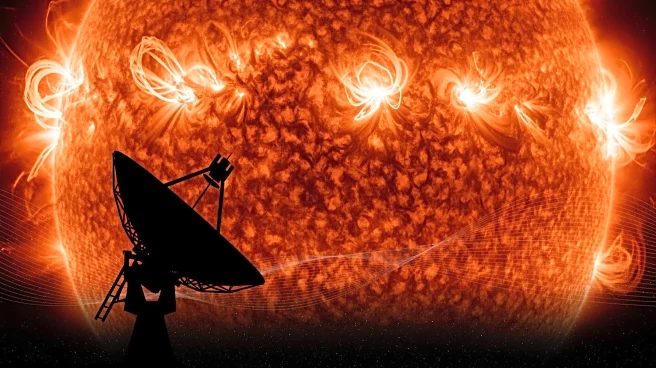
A significant solar event has occurred with a powerful X-class solar flare releasing a coronal mass ejection (CME) expected to impact Earth. The CME, originating from sunspot region AR4341, is anticipated to reach Earth within 24 hours. This event has the
potential to cause strong (G3) to severe (G4) geomagnetic storm conditions, according to forecasts from the UK Met Office. Such storms can disrupt satellite operations and GPS navigation, and may also enhance auroral activity, making the aurora borealis visible much further south than usual, potentially reaching areas like Northern California and Alabama. The US National Oceanic and Atmospheric Administration's Space Weather Prediction Center reported that the solar flare peaked at 18:09 GMT, causing radio blackouts over the Americas.
Why It's Important?
The potential geomagnetic storms resulting from this solar event could have significant implications for various sectors. Disruptions to satellite operations and GPS navigation can affect aviation, maritime operations, and critical infrastructure. The increased auroral activity could also impact power grids and communication systems. These disruptions highlight the vulnerability of modern technology to space weather events and underscore the importance of monitoring and preparing for such occurrences. Industries reliant on precise navigation and communication systems may face operational challenges, and there could be broader economic impacts if the geomagnetic storms are severe.
What's Next?
Space weather forecasters are closely monitoring the situation to refine predictions about the CME's arrival and its potential impact. The true magnetic orientation of the CME, which will determine the severity of its interaction with Earth's magnetic field, will only be known as it approaches closer to Earth. Solar wind monitoring satellites like DSCOVR and ACE will provide critical data. Stakeholders in affected industries, such as aviation and telecommunications, are likely to prepare for possible disruptions. Public and private entities may issue alerts and advisories to mitigate the impact on infrastructure and services.
Beyond the Headlines
This event underscores the ongoing need for advancements in space weather forecasting and the development of more resilient infrastructure. The potential for increased auroral activity also presents opportunities for scientific research and public engagement with space phenomena. However, it also raises questions about the preparedness of current systems to handle such natural events and the need for international cooperation in space weather monitoring and response.