



What's Happening?
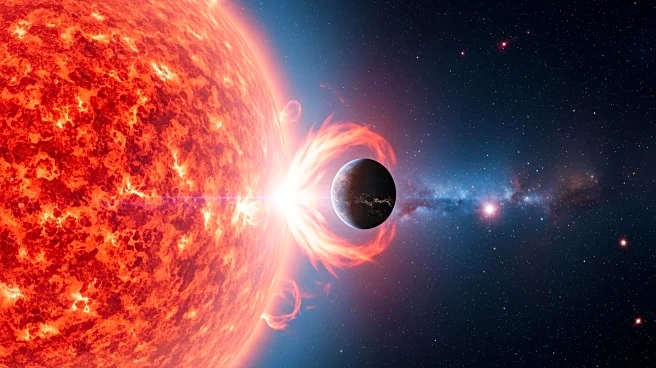
Researchers have provided insights into how dying stars might consume their planets, including Earth. Using data from the TESS observatory, astronomers Edward Bryant and Vincent Van Eylen studied stars at different life stages, noting that planets become
rarer as stars age. This phenomenon is attributed to the expansion of stars as they exhaust their hydrogen fuel, potentially engulfing nearby planets. The study identified 456,941 post-main-sequence stars and found 130 planets with close-in orbits, suggesting that tidal forces from aging stars can strip planets of their atmospheres and destroy them.
Why It's Important?
The research offers a glimpse into the long-term fate of our solar system, emphasizing the inevitability of cosmic evolution. Understanding how stars consume planets can inform future studies on planetary formation and survival. This knowledge is crucial for astronomers and scientists as they explore the dynamics of exoplanetary systems and the potential for life beyond Earth. The findings also highlight the importance of continued space exploration and research to better understand the universe's complexities and prepare for future cosmic events.
What's Next?
Further research is needed to refine the understanding of metallicity's impact on planet occurrence rates. As scientists gather more data, they can improve predictions about the fate of planets in various star systems. This ongoing research will contribute to the broader field of exoplanet science, potentially leading to new discoveries about planetary survival and the conditions necessary for life. Collaboration among astronomers worldwide will be essential to advance this field and uncover more about the universe's mysteries.