




What's Happening?
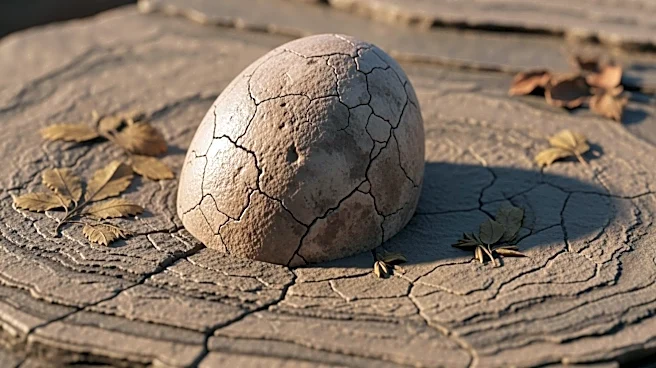
For over two decades, a collection of small dinosaur fossils puzzled scientists, who initially believed they belonged to a miniature species. Recent research, however, has reclassified these fossils as baby ankylosaurs, some possibly just hatched. These
fossils, discovered in Liaoning Province, China, were initially thought to be a rare miniature version of dinosaurs due to their small size, measuring only 40 centimeters. The study, published in the Journal of Vertebrate Paleontology, used bone structure analysis to determine that these fossils were indeed juvenile ankylosaurs. The absence of growth lines in the bones indicated that these dinosaurs were less than a year old. This discovery provides valuable insights into the early development of armored dinosaurs, as juvenile ankylosaur fossils are rare.
Why It's Important?
This reclassification is significant for paleontology as it enhances the understanding of dinosaur development, particularly for ankylosaurs. The discovery that these fossils are juveniles rather than a separate miniature species helps clarify the growth patterns and development of armor in ankylosaurs. This finding also underscores the importance of Liaoning Province as a rich source of well-preserved fossils, offering insights into the Cretaceous period. The ability to study juvenile fossils provides a unique opportunity to understand the life stages of dinosaurs, which can inform broader evolutionary studies and improve the accuracy of paleontological models.
What's Next?
Researchers aim to find an adult Liaoningosaurus fossil to compare the differences in armor development from youth to adulthood. Such a discovery would further illuminate the growth processes of ankylosaurs and potentially reveal more about their life history. Continued exploration in Liaoning Province is likely, given its status as a fossil hotspot, which could lead to more significant discoveries that enhance the understanding of dinosaur evolution and development.