





What's Happening?
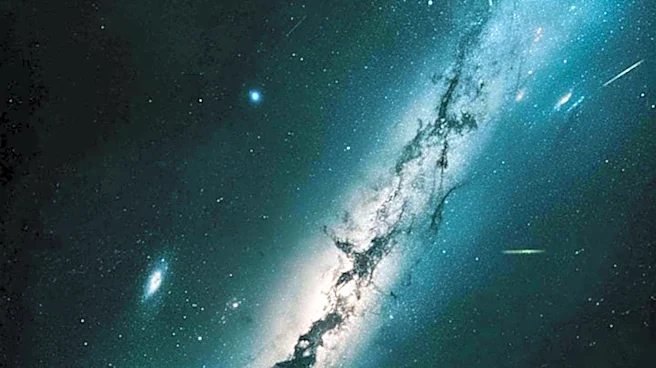
Astronomers working on the ARMA (Cluster Ages to Reconstruct the Milky Way Assembly) project have uncovered evidence of the Milky Way's earliest act of 'cannibalism,' a merger event that occurred approximately 12 billion years ago. This discovery pushes
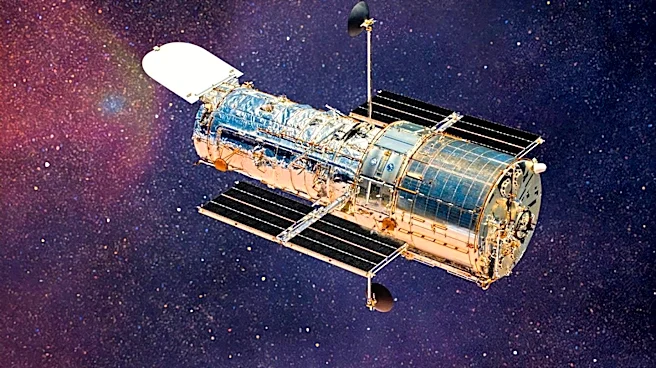
back the known history of galactic mergers by 1.8 billion years, predating the previously identified Gaia-Enceladus merger. The team utilized data from the Hubble Space Telescope to analyze globular clusters, which are dense conglomerations of ancient stars. By developing a new technique to determine the age and metallicity of these clusters with greater precision, they identified three distinct groups. One group was linked to the Gaia-Enceladus merger, another to the original Milky Way, and a third, previously unknown group, indicated an even earlier merger. This third group of globular clusters revealed that the devoured galaxy had a mass of about 500 million times that of the sun, similar in size to Gaia-Enceladus, while the Milky Way currently has a mass of around 1.5 trillion solar masses.
Why It's Important?
This discovery significantly enhances our understanding of the early formation and evolution of the Milky Way galaxy. By identifying a merger event that occurred 12 billion years ago, astronomers are gaining insights into the galaxy's infancy and the processes that shaped its subsequent development. The 'scarring' left behind by this ancient galactic meal provides crucial clues about the violent and dynamic history of our galaxy. Understanding these early mergers is fundamental to comprehending how large spiral galaxies like the Milky Way grow and accumulate mass over cosmic time. This research also highlights the power of advanced observational techniques and data analysis, particularly with instruments like the Hubble Space Telescope, in unraveling the universe's deep past. The findings contribute to the broader field of astrophysics, offering a more complete picture of galactic evolution and the mechanisms driving cosmic structure formation.
What's Next?
The findings from the ARMA project open new avenues for research into the Milky Way's formative years. Future investigations will likely focus on further characterizing the properties of this newly identified 'doomed galaxy' and its impact on the early Milky Way. Astronomers may seek to identify more subtle traces of this merger or other potential early events using advanced telescopes and data analysis techniques. The improved precision in dating globular clusters could be applied to other galaxies to reconstruct their merger histories, providing a comparative framework for understanding galactic evolution across the universe. Continued analysis of existing and future Hubble data, potentially complemented by observations from newer telescopes, will be crucial in refining these models and uncovering additional details about the Milky Way's complex past.
Beyond the Headlines
This discovery delves into the fundamental question of cosmic origins, offering a piece of the answer to 'where do we come from?' by illuminating the very beginnings of our galactic home. The concept of 'galactic cannibalism' underscores the dynamic and often violent nature of the universe, where larger structures grow by absorbing smaller ones. This process is not merely a historical event but an ongoing mechanism that continues to shape galaxies today. The research also highlights the ingenuity of scientific inquiry, where seemingly small anomalies in data – like the distinct third group of globular clusters – can lead to profound revelations about cosmic history. It reinforces the idea that the universe holds many secrets, and with persistent observation and innovative analytical methods, we can gradually piece together its intricate narrative, from the smallest stellar remnants to the grandest galactic collisions.