




What's Happening?
Two physics professors at the University of Rhode Island (URI), Derek Davis and Deborah Ferguson, have been awarded individual grants from the National Science Foundation (NSF) to further their research into black holes. Professor Davis received a $260,886
grant over two years through NSF’s Established Program to Stimulate Competitive Research Fellows (EPSCoR) project. This funding will facilitate collaboration between URI and the Laser Interferometer Gravitational-Wave Observatory (LIGO) in Washington state, aiming to enhance the detection capabilities for black holes. Professor Ferguson was awarded $150,000 over three years to focus on understanding black hole mechanics and establishing a waveform database for accurate identification of black holes in outer space. Both professors have a history of extensive black hole research at URI, including their involvement last year in an astrophysics team whose work helped LIGO identify hundreds of gravitational wave signals.
Why It's Important?
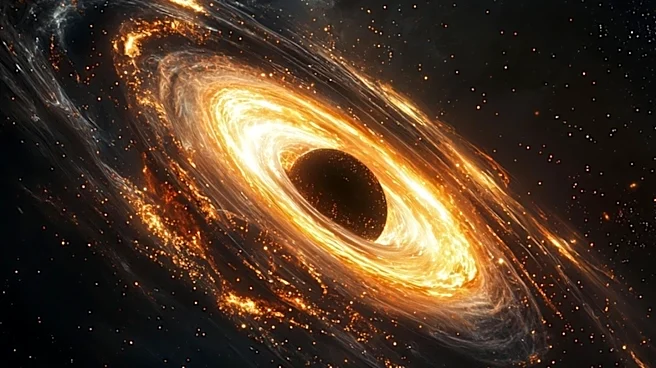
This NSF funding is crucial for advancing the understanding of black holes and their role in shaping the universe. The collaboration between URI and LIGO, supported by Professor Davis's grant, is expected to improve the detection of gravitational waves, which are key to observing black hole mergers. By developing new methods to filter out noise and enhance signal clarity, researchers will gain a sharper vision of these cosmic events. Professor Ferguson's work on establishing a waveform database will provide a critical tool, akin to a 'Shazam' for black holes, enabling scientists to identify specific black holes, their sizes, and the masses they create. This research will not only deepen astrophysical knowledge but also contribute to a better understanding of how galaxies evolve and how the universe reached its current state, impacting the broader scientific community and potentially inspiring future generations of researchers.
What's Next?
Professor Davis's grant will support travel for him and a URI graduate student to visit LIGO, where they will collaborate with researchers to develop new gravitational wave detection methods. This will involve conducting on-site tests, including playing music to observe how laboratory detectors respond. The research will also include studying stellar remnants to better understand the universe's evolution through black holes. Professor Ferguson will utilize 'numerical relativity' to simulate black hole mergers and predict gravitational wave patterns, contributing to the waveform database. Both projects aim to increase the clarity and frequency of black hole signal detection. The synergy between their research, as noted by Professor Davis, suggests a coordinated effort to make significant discoveries and improve the types of astrophysics being conducted.
Beyond the Headlines
The research undertaken by Professors Davis and Ferguson extends beyond immediate detection improvements, delving into fundamental questions about the universe's origins and evolution. By creating a comprehensive database of gravitational waves and simulating black hole mergers, they are building a foundational understanding that could unlock secrets about the abundance, masses, and spins of black holes. This, in turn, will inform theories on how galaxies form and change over cosmic timescales. The use of 'numerical relativity' to solve Einstein's equations highlights the interdisciplinary nature of modern astrophysics, combining theoretical physics with advanced computational methods. The long-term implications include a more complete cosmological model and potentially new insights into the nature of spacetime itself, pushing the boundaries of human knowledge.