


What's Happening?
NASA has announced a new call for research proposals under its Research Opportunities in Space and Earth Sciences (ROSES) program, specifically targeting the NISAR Data, Applications, Research, and Technology (DART) team. This initiative seeks to utilize
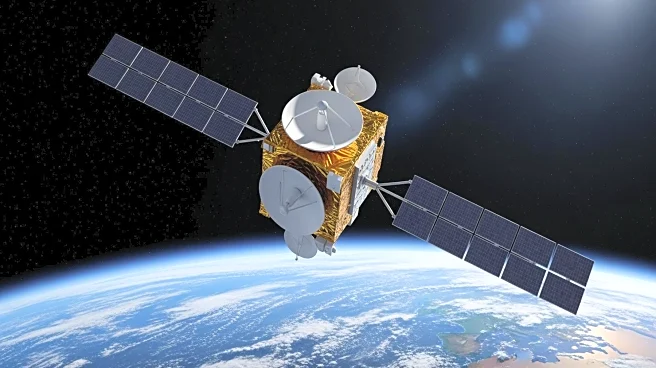
the NASA-ISRO Synthetic Aperture Radar (NISAR) satellite's dual-frequency L-band and S-band radar observations to enhance Earth system science and its applications. The NISAR satellite is designed to provide comprehensive global coverage of Earth's land and ice surfaces every 12 days, facilitating detailed analysis across various domains such as the geosphere, biosphere, cryosphere, and hydrosphere. The data, estimated at 30 petabytes annually, will be archived and distributed by the Alaska Satellite Facility Distributed Active Archive Center. A small sample of L-band products is already available for public access, allowing researchers to begin developing workflows in anticipation of larger data releases planned for 2026.
Why It's Important?
The NISAR satellite's capabilities are expected to significantly advance scientific understanding in several critical areas. By providing detailed data on Earth surface deformation, carbon storage, ecosystem changes, cryosphere dynamics, and global soil moisture patterns, the satellite will support a wide range of applications. These include hazard response, agricultural monitoring, and infrastructure management. The research facilitated by this program could lead to improved predictive models and strategies for addressing environmental challenges such as sea level rise and climate change. The collaboration between NASA and ISRO also highlights the importance of international partnerships in advancing global scientific objectives.
What's Next?
The proposal process for this program involves two steps, with initial proposals due by March 13, 2026, and final proposals by May 14, 2026. Selected researchers will join the NISAR DART team, working closely with NASA's Earth Science Division to drive scientific discovery and innovation using NISAR data. This collaboration aims to accelerate the development of new applications and insights from the satellite's observations. Researchers interested in participating are encouraged to review the available data and training materials to prepare their submissions effectively.