







What's Happening?
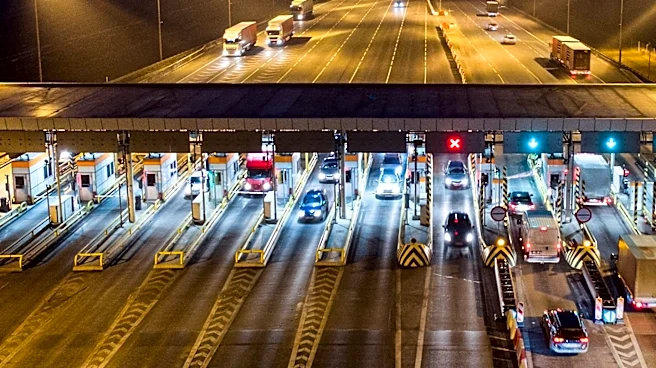
Southern California is actively expanding its network of managed toll lanes to address severe traffic congestion and improve highway efficiency. The region, encompassing Los Angeles, Orange, Riverside, San Bernardino, and Ventura counties, currently has
286 miles of managed lanes, with San Diego's I-15 express lanes contributing an additional 80 miles. These managed lanes are variably priced toll lanes added alongside existing freeway lanes, ensuring that no free lanes are converted to toll lanes. The pricing adjusts throughout the day to manage demand and maintain free-flowing traffic, even during peak hours. While critics sometimes label these as 'Lexus lanes,' traffic studies indicate that the vehicle types using them mirror the general population of vehicles on U.S. roads, with lower-income drivers reporting higher satisfaction due to the ability to make time-sensitive trips. Managed lanes are under construction on I-105 near Los Angeles International Airport, and the Southern California Association of Governments plans extensions on I-105, I-10, and I-15, as well as new toll lanes on I-5 and SR 60. Most of these projects represent added capacity, though some involve converting existing carpool lanes.
Why It's Important?
The expansion of managed toll lanes in Southern California is a significant development for regional transportation and economic activity. Drivers in the area face some of the highest gas taxes and considerable time lost to traffic jams. This initiative aims to provide congestion-free options, which can lead to more reliable travel times for commuters, businesses, and emergency services. The variable pricing model ensures that these lanes remain efficient, offering a choice for those willing to pay for faster transit, particularly for time-sensitive journeys like airport trips or medical appointments. By reducing overall traffic, these lanes can also contribute to lower fuel consumption and potentially reduced emissions. The strategy also highlights a shift towards public-private partnerships for infrastructure development, which can help fund costly projects, transfer financial risks from taxpayers to investors, and introduce more efficient management practices. This approach could serve as a model for other congested urban areas across the U.S. seeking innovative solutions to infrastructure challenges.
What's Next?
The Southern California region anticipates a continued expansion of its managed lane network, with the goal of connecting key destinations and offering drivers a comprehensive congestion-free travel option. The Southern California Association of Governments is planning further extensions on major interstates, including I-105, I-10, and I-15, and new toll lanes on I-5 and SR 60. A recent policy paper by the Reason Foundation identified several viable corridors for additional managed lane expansion in Los Angeles, Orange, and San Diego counties, suggesting new lanes on I-5 and conversions of existing carpool lanes on I-10, I-405, US 101, SR 55, SR 57, and SR 60. In San Diego, the study recommended adding managed lanes on I-5, I-8, I-805, SR 52, SR 54, SR 94, and SR 125. While many of these projects were initially excluded from long-range transportation plans due to high costs, the emphasis on public-private partnerships suggests a pathway for their realization, potentially accelerating the development of a more efficient road network.
Beyond the Headlines
The expansion of managed toll lanes in Southern California carries deeper implications beyond immediate traffic relief. It represents a fundamental shift in how urban infrastructure is funded and utilized, moving towards a user-pays model for premium services within public goods. This approach raises questions about equitable access, despite studies suggesting that lower-income drivers benefit from the option for critical trips. The reliance on public-private partnerships also introduces new dynamics in infrastructure development, potentially influencing project timelines, cost management, and the distribution of financial risk. Furthermore, the success of this model in Southern California could set a precedent for other major U.S. metropolitan areas grappling with similar congestion issues, potentially leading to a broader adoption of variably priced managed lanes and a re-evaluation of traditional public funding mechanisms for transportation. The long-term impact on urban planning, commuter behavior, and regional economic competitiveness will be a critical area for observation.