



What's Happening?
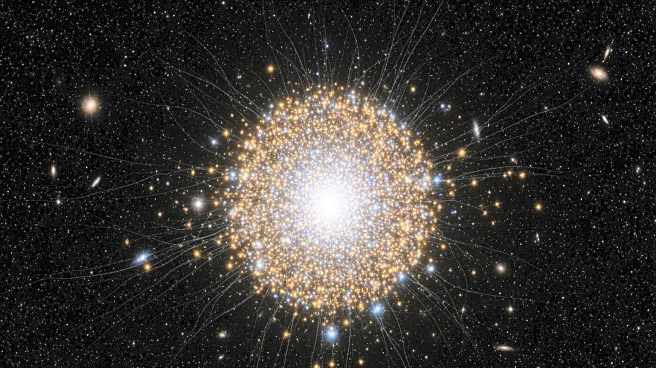
A team of astronomers led by Joanne Hughes from Seattle University has observed the galactic globular cluster NGC 6569, located in the Milky Way's bulge, using the Anglo-Australian Telescope (AAT). The study, part of the Milky Way Bulge Extra-Tidal Star
Survey (MWBest), aims to understand the dissolution of globular clusters in the inner Milky Way. The findings reveal that NGC 6569 is actively losing stars through a process known as tidal stripping. This cluster, approximately 35,500 light years from Earth, is losing about 5.6% of its mass every billion years, contributing to the bulge field population at a rate of 1.0–1.6 solar masses per year. The research identified 40 stars as tidal debris, with five forming a halo around the cluster. These observations suggest that NGC 6569 is moving through a tube of its own tidal debris, although further studies are needed to confirm this hypothesis.
Why It's Important?
The study of NGC 6569's star loss through tidal stripping provides valuable insights into the dynamics and evolution of globular clusters in the Milky Way. Understanding these processes is crucial for astronomers as it helps explain the distribution and movement of stars within our galaxy. The findings highlight the significant impact of tidal forces on globular clusters, which can lead to substantial mass loss over time. This research contributes to the broader understanding of galactic structure and the role of globular clusters in the Milky Way's evolution. The ongoing mass loss in NGC 6569 also underscores the importance of continued observation and study of these celestial phenomena to better comprehend the complex interactions within our galaxy.
What's Next?
Further studies, particularly N-body simulations, are required to verify the hypothesis that NGC 6569 is moving through a tube of its own tidal debris. These simulations will help refine the understanding of the cluster's dynamics and the extent of its mass loss. Additionally, continued observations of NGC 6569 and other globular clusters in the Milky Way's bulge will provide more data on the effects of tidal stripping. This research could lead to new insights into the life cycle of globular clusters and their contribution to the galactic environment. The findings may also prompt further exploration of the mechanisms driving mass loss in other clusters, enhancing the overall knowledge of galactic evolution.