



What's Happening?
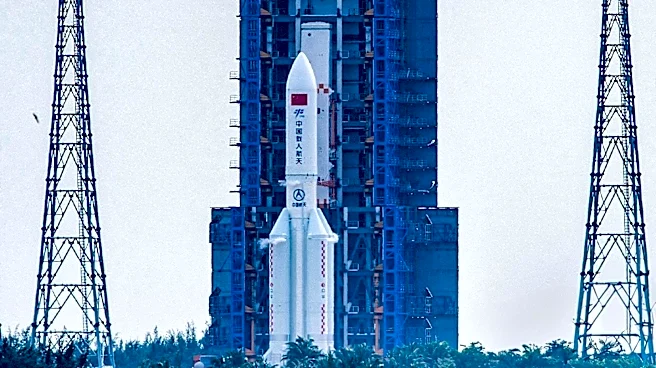
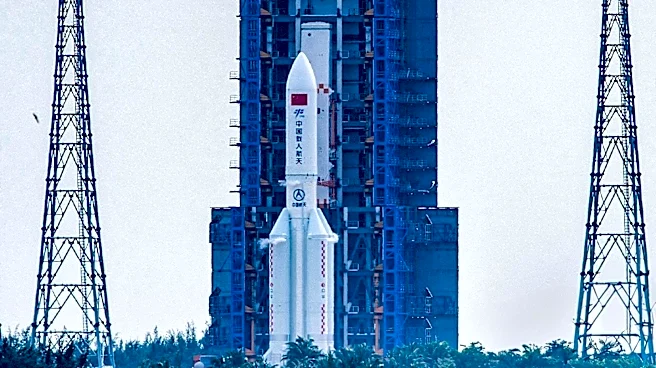
China has successfully recovered its first reusable rocket booster, marking a significant achievement in its space exploration efforts. The China Aerospace Science and Technology Corporation (CASC) managed to recover the booster of the Long March 10B
rocket shortly after its launch from the Wenchang Commercial Space Launch Site. The booster was caught by a net-rigged recovery ship in the South China Sea, demonstrating China's capability to reuse rocket components, a technology pioneered by SpaceX. This development is part of China's broader strategy to enhance its space capabilities and compete with global leaders in space technology.
Why It's Important?
The successful recovery of a reusable rocket booster is a major step forward for China's space program, potentially reducing the cost of space launches and increasing the frequency of missions. This achievement positions China as a formidable player in the global space race, challenging the dominance of companies like SpaceX. The ability to reuse rocket components could accelerate China's plans for satellite deployment, space station operations, and future lunar missions. This technological advancement also reflects China's growing investment in space exploration, which has implications for international space cooperation and competition.
What's Next?
China plans to continue developing its reusable rocket technology, with future missions aimed at enhancing its capabilities in space exploration. The Long March 10B is part of a series of rockets designed for various missions, including crewed spaceflights and commercial satellite launches. China's success in this area may lead to increased collaboration or competition with other space-faring nations. The country is also working on a heavier version of the Long March 10 for its lunar program, with the goal of landing astronauts on the Moon by 2030. These developments will be closely monitored by the global space community.