



What's Happening?
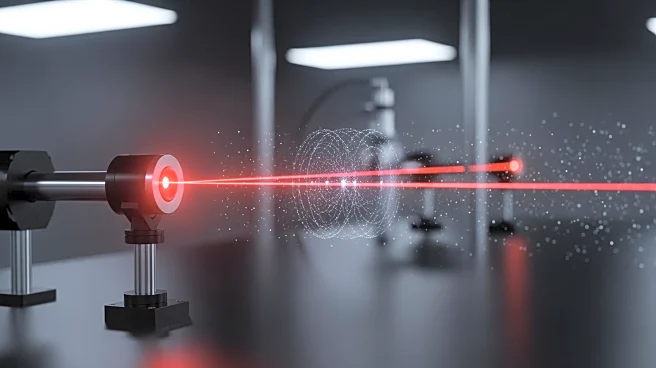
A new experiment proposed by Prof. Ralf Schützhold aims to measure the energy exchange between light waves and gravitational waves, potentially proving the existence of gravitons. The experiment involves using laser pulses in an interferometer to detect
minute changes in light wave frequency caused by the absorption or emission of gravitons. This could provide insights into the quantum nature of gravity, a long-standing theoretical concept.
Why It's Important?
This experiment represents a significant step towards understanding the quantum properties of gravity, a fundamental force in physics. Proving the existence of gravitons would bridge the gap between quantum mechanics and general relativity, two pillars of modern physics. The findings could revolutionize our understanding of the universe and lead to new technologies based on quantum gravitational interactions.
What's Next?
The proposed experiment requires significant technological advancements and collaboration among physicists and engineers. If successful, it could pave the way for further research into quantum gravity and the development of new experimental techniques. The scientific community may increase efforts to design and build the necessary equipment, potentially leading to breakthroughs in both theoretical and experimental physics.
Beyond the Headlines
The pursuit of measuring graviton energy exchange highlights the ongoing quest to unify quantum mechanics and general relativity. It underscores the importance of interdisciplinary research and innovation in addressing fundamental questions about the universe. The experiment could also inspire new theoretical models and experimental approaches in the study of gravitational waves and quantum phenomena.