
What's Happening?
In Bangladesh, the integration of drone technology into agriculture is emerging as a promising solution to enhance productivity and sustainability. With a growing population and decreasing cultivable land,
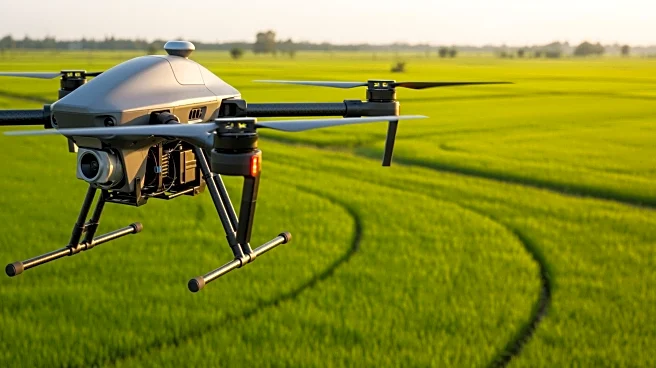
traditional farming methods are insufficient to meet the rising food demand. Drones offer a new dimension to agricultural monitoring and management, equipped with high-resolution cameras and advanced sensors. They enable farmers to observe crop conditions with greater accuracy, detect early signs of disease, and apply fertilizers and pesticides precisely. This technology helps in efficient irrigation management by collecting data on soil moisture levels, thus conserving water resources and enhancing crop resilience. Despite its potential, the adoption of drone technology in Bangladesh faces challenges such as high initial costs and the need for financial support.
Why It's Important?
The adoption of drone technology in agriculture is significant as it can lead to increased efficiency, higher crop yields, and improved farm profitability. By reducing waste and lowering input costs, drones can help stabilize agricultural output and reduce dependency on food imports. This technological shift also opens new opportunities for youth employment and entrepreneurship in rural areas, potentially reducing rural-urban migration. The integration of drones into agriculture aligns with ecological sustainability by minimizing chemical runoff and supporting environmentally responsible farming practices. However, widespread adoption requires coordinated efforts from the government, private sector, and academic institutions to address existing challenges.