





What's Happening?
The U.S. District Court for the Northern District of New York has ruled against the State of New York's 'Climate Change Superfund Act,' preventing its enforcement. This act, enacted in 2024, aimed to impose billions of dollars in liability on domestic
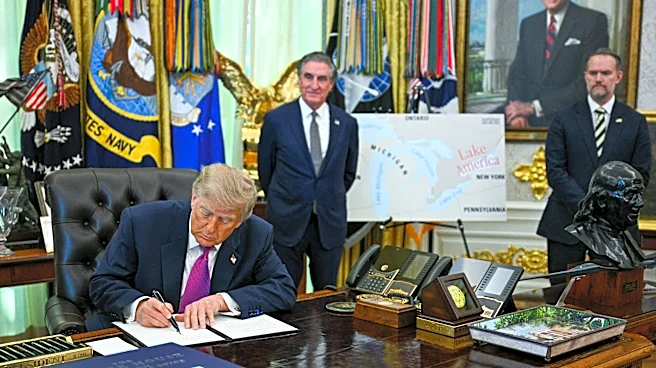
and foreign energy companies involved in fossil fuel extraction or crude oil refining for their alleged contributions to global greenhouse gas emissions. A coalition of states and trade organizations challenged the law, arguing it was preempted by the federal Clean Air Act and federal foreign affairs power, and violated the U.S. Constitution. The Department of Justice (DOJ) filed a statement of interest and presented oral arguments supporting the plaintiffs, aligning with President Trump's directive to protect American energy from state overreach. Principal Deputy Assistant Attorney General Adam Gustafson of the Justice Department’s Energy and Natural Resources Division (ENRD) stated that the law would have expropriated $75 billion from energy companies, defying American foreign policy and federal law. The court agreed with the preemption arguments, declaring the New York Climate Change Superfund Act invalid.
Why It's Important?
This ruling is significant for the energy sector and state-federal relations, particularly concerning environmental policy. The Department of Justice's intervention, driven by President Trump's Executive Order 14260, underscores a federal commitment to preventing state laws that are perceived to unduly burden domestic energy development. Had it been upheld, New York's Climate Superfund Act could have set a precedent for other states to pursue similar legislation, potentially leading to a patchwork of state-level climate regulations that conflict with federal authority and international agreements. The $75 billion liability estimate highlights the substantial financial impact such laws could have on energy companies, potentially affecting energy prices and supply reliability across the nation. The decision reinforces the federal government's role in regulating interstate commerce and foreign policy, limiting states' abilities to impose broad economic penalties on industries operating across state and international lines.
What's Next?
The Department of Justice has also filed complaints challenging similar climate superfund acts in the U.S. District Court for the Southern District of New York and the U.S. District Court for the District of Vermont. These lawsuits allege that both the New York and Vermont acts are preempted by the federal Clean Air Act and federal foreign affairs power, and violate the U.S. Constitution. The DOJ is seeking declarations that these state laws are unconstitutional and injunctions against their enforcement. The outcome of these ongoing legal challenges will further define the boundaries of state authority in climate regulation and its intersection with federal law and foreign policy. Energy companies and environmental groups will closely monitor these cases, as they could influence future legislative efforts and corporate liabilities related to climate change.
Beyond the Headlines
The legal battle over New York's Climate Superfund Act touches upon fundamental questions of federalism and the balance of power between state and federal governments in addressing complex issues like climate change. While states often act as laboratories for policy innovation, this ruling suggests that federal preemption can limit state actions, especially when they impact national economic interests or foreign policy. The case also highlights the ongoing tension between environmental protection goals and economic considerations, particularly in the energy sector. The DOJ's stance emphasizes the importance of a unified national approach to energy policy and international relations, rather than fragmented state-level initiatives. This decision could encourage a more coordinated federal strategy for climate action or prompt states to devise new legislative approaches that are less susceptible to preemption challenges.