
What's Happening?
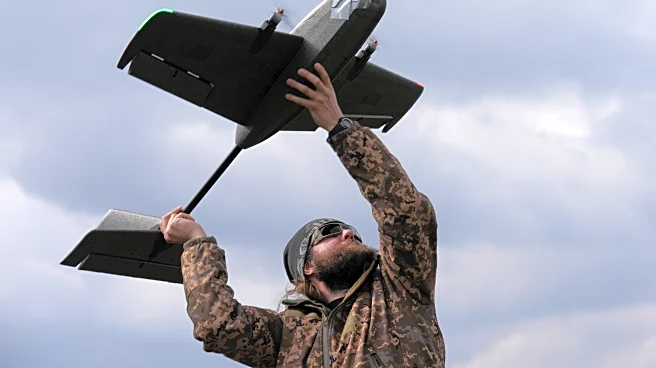
Ukraine has announced its capability to supply allies with 1,000 anti-Shahed interceptor drones daily, potentially more with increased investment. This offer comes as Ukraine leverages its industrial capacity to support countries facing drone threats,
particularly from Iran's Shahed drones. Ukrainian President Volodymyr Zelenskyy highlighted this capability during a speech to the UK Parliament, emphasizing Ukraine's experience in countering such threats. The country's defense industry, while currently limited by funding, has the potential to produce significantly more interceptors. The demand for these drones has surged, especially as traditional air defense systems prove costly and less effective against the relatively inexpensive Shahed drones. Ukraine's approach, which involves using cost-effective interceptor drones, has attracted interest from multiple countries seeking to bolster their defenses.
Why It's Important?
The ability of Ukraine to supply interceptor drones is significant in the context of global defense strategies, particularly for countries facing threats from Iran's Shahed drones. These drones have been used against US forces and allies in the Middle East, highlighting the need for effective and affordable defense solutions. Ukraine's offer could alleviate the financial burden on countries relying on expensive traditional air defense systems, such as the US-made Patriot missiles. By providing a cost-effective alternative, Ukraine positions itself as a key player in the global defense market, potentially boosting its economy through exports. This development also underscores the strategic importance of technological innovation in modern warfare, as countries seek to adapt to evolving threats.
What's Next?
For Ukraine, securing additional investments will be crucial to scaling up production and meeting the growing demand for interceptor drones. The country is also working on steps to increase exports, particularly to European partners, although these processes are still being finalized. As Ukraine continues to refine its defense technologies, it may further solidify its role as a provider of military solutions. For countries interested in Ukraine's interceptors, collaboration and investment will be key to integrating these systems into their defense strategies. The broader geopolitical landscape may also influence the dynamics of these partnerships, as nations navigate the complexities of international defense cooperation.