
What's Happening?
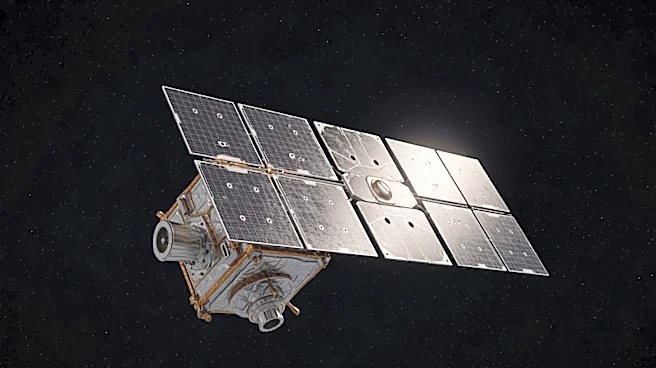
NASA has officially decommissioned the Mars Atmosphere and Volatile EvolutioN (MAVEN) spacecraft after six months of unsuccessful attempts to reestablish contact. MAVEN, which had been studying Mars' atmosphere
since 2014, went silent in December 2025. An anomaly review board determined that the spacecraft could not be recovered due to a spin that likely prevented its solar panels from charging. MAVEN's mission provided significant insights into Mars' atmospheric loss and contributed to over 800 scientific publications. Despite its decommissioning, MAVEN's data will continue to support future research.
Why It's Important?
The decommissioning of MAVEN marks the end of a significant chapter in Mars exploration. MAVEN's findings have been crucial in understanding how Mars lost its atmosphere, a key question in planetary science. The mission's data will continue to inform future research and missions to Mars. MAVEN's contributions to the Mars Relay Network, which facilitates communication between Mars rovers and Earth, highlight its importance in supporting ongoing and future Mars exploration efforts. The lessons learned from MAVEN's mission will guide the development of new communication infrastructures for Mars missions.
What's Next?
With MAVEN's decommissioning, NASA will rely on the remaining orbiters in the Mars Relay Network to support communication with Mars rovers. NASA has issued a request for proposals for the Mars Telecom Network, a new communication infrastructure to support future robotic and crewed missions to Mars. This initiative aims to build on MAVEN's legacy and ensure robust communication capabilities for upcoming Mars exploration efforts. The industry responses to this proposal are due by June 15, 2026, indicating a proactive approach to maintaining and enhancing Mars mission support.