







What's Happening?
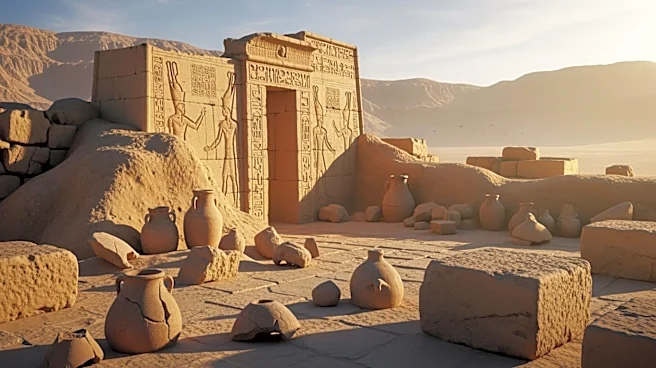
On April 1, 2471 B.C., a total solar eclipse occurred over ancient Egypt, potentially marking the end of sun worship during the reign of Pharaoh Shepsekaf of the Fourth Dynasty. Giulio Magli, a professor at the Politecnico di Milano, suggests that the eclipse's
path coincides with a period when Egyptians began to move away from sun worship. Historically, the sun was central to Egyptian religion, with gods like Horus and Ra being significant figures. However, Shepsekaf's reign marked a departure from these traditions, as his name did not reference Ra, and his tomb was not a pyramid aligned with solar beliefs. Instead, it resembled structures in Buto, the city at the center of the eclipse's totality. This shift in religious practice has been linked to the eclipse through recent advances in eclipse modeling.
Why It's Important?
The potential link between the solar eclipse and the end of sun worship in ancient Egypt highlights the influence of celestial events on historical religious practices. This development underscores the role of natural phenomena in shaping cultural and religious shifts. Understanding these connections provides insight into how ancient societies interpreted and responded to astronomical events. The study of such historical events can inform modern interpretations of how societies adapt to and are influenced by natural occurrences. Additionally, this research contributes to the broader field of archaeoastronomy, offering a deeper understanding of the interplay between astronomy and ancient cultures.
What's Next?
Further research into the impact of celestial events on ancient cultures could provide additional insights into the historical significance of such phenomena. Scholars may continue to explore the relationship between eclipses and religious or cultural changes in other ancient civilizations. This could involve examining archaeological evidence and historical texts to identify similar patterns. The findings could also influence contemporary discussions on the role of natural events in shaping human history and cultural evolution.
Beyond the Headlines
The study of the solar eclipse's impact on ancient Egyptian religion raises questions about the broader implications of celestial events on human belief systems. It highlights the potential for natural phenomena to serve as catalysts for significant cultural transformations. This research also prompts consideration of how modern societies might be influenced by similar events, particularly in the context of climate change and other global challenges. The exploration of these themes can contribute to a deeper understanding of the dynamic relationship between humanity and the natural world.