




What's Happening?
U.S. Rep. Brendan Boyle, a Democrat from Philadelphia, announced plans to introduce legislation establishing a federal commission to organize events for the 250th anniversary of the signing of the U.S. Constitution. The anniversary is scheduled for September
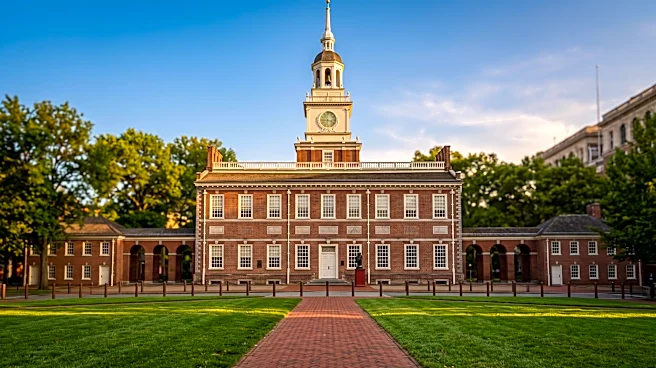
17, 2037. Boyle made the announcement at the National Constitution Center, emphasizing the need for early preparation, approximately 11 years in advance. The proposed commission would comprise federal, state, and local officials, alongside civic leaders, to coordinate the commemoration. Boyle cited the 1987 bicentennial of the Constitution as a successful model for such a large-scale civic event. Vince Stango, interim president and CEO of the National Constitution Center, supported the initiative, suggesting it could sustain investment in educational, civic, and cultural institutions and engage more Americans with the nation's constitutional history. This proposal follows Boyle's previous efforts to highlight Philadelphia's historical significance, including organizing a bipartisan congressional gathering at Independence Hall in July to mark the 250th anniversary of the Continental Congress's vote for independence.
Why It's Important?
This initiative is significant as it aims to leverage a major historical anniversary to foster civic engagement and education across the United States. By establishing a federal commission, Boyle seeks to ensure a coordinated and impactful commemoration that extends beyond mere celebration, focusing on the enduring relevance of the Constitution. The effort could stimulate public investment in civic and educational programs, potentially strengthening national understanding of foundational American principles. For Philadelphia, the proposal reinforces its role as a central historical site, potentially attracting national attention and tourism, similar to past anniversaries. The emphasis on bipartisan collaboration, as demonstrated by Boyle's previous actions, suggests an attempt to unite diverse political viewpoints around shared national heritage, which could be crucial in a polarized political climate. Furthermore, by framing the period between 2026 and 2041 as a 'civic decade,' the National Constitution Center and Boyle aim to create sustained engagement with constitutional history, rather than a one-off event.
What's Next?
The immediate next step involves U.S. Rep. Brendan Boyle formally introducing the legislation in Congress to create the federal commission. Following its introduction, the bill would need to navigate the legislative process, including committee reviews, potential amendments, and votes in both the House of Representatives and the Senate. If passed by Congress and signed into law, the commission would then be established, and its members appointed. These members would subsequently begin the extensive planning process for the 2037 anniversary, which would involve developing themes, identifying key events, securing funding, and coordinating with various stakeholders at federal, state, and local levels. Public and private partnerships would likely be sought to support the commemoration. The success of the commission will depend on its ability to garner bipartisan support and effectively engage a broad spectrum of American society in the lead-up to 2037.
Beyond the Headlines
Beyond the immediate planning for the 2037 anniversary, this proposal touches upon deeper societal implications regarding civic literacy and national identity. In an era marked by concerns about declining civic knowledge and increasing political polarization, a national commemoration of the Constitution offers an opportunity to re-engage citizens with the foundational principles of American democracy. The initiative could serve as a catalyst for renewed educational efforts in schools and public forums, encouraging a deeper understanding of constitutional rights and responsibilities. Ethically, it presents a chance to reflect on the ongoing evolution and interpretation of the Constitution, addressing contemporary challenges through the lens of historical context. Culturally, such an event could foster a sense of shared national purpose and pride, transcending partisan divides by focusing on common heritage. The long-term impact could be a more informed and engaged citizenry, better equipped to participate in democratic processes and uphold constitutional values.