






What's Happening?
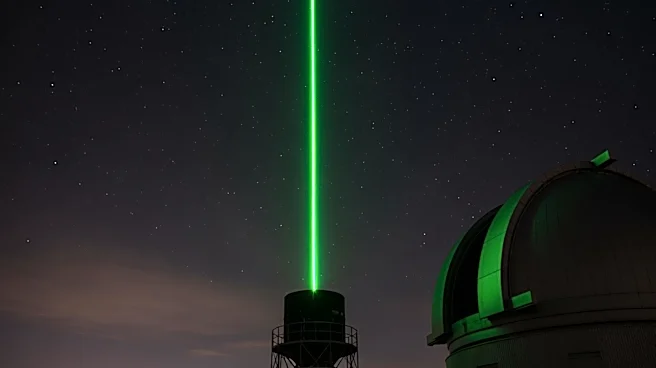
Astronomers at the European Southern Observatory's Very Large Telescope Interferometer (VLTI) in Chile are utilizing lasers to create 'artificial stars' in the sky. This technique is employed to measure atmospheric turbulence, which can distort astronomical
observations. By observing how these laser-created points of light blur and disturb molecules in Earth's atmosphere, scientists can use computer algorithms to account for and cancel out these disturbances. This method, known as adaptive optics, is still in its developmental stages and is used by only a few observatories worldwide. The VLTI, which consists of four separate telescopes working together as one large virtual telescope, has been using this system since 2016.
Why It's Important?
The use of laser guide stars and adaptive optics represents a significant advancement in astronomical technology, allowing for clearer and more accurate observations of the universe. This development is crucial for astronomers as it enhances their ability to study distant celestial objects without the interference of atmospheric distortion. The progress in this field could lead to new discoveries and a better understanding of the cosmos, benefiting scientific research and potentially leading to technological innovations. The ability to observe the universe with greater clarity can also inspire public interest and support for space exploration and research.