
What's Happening?
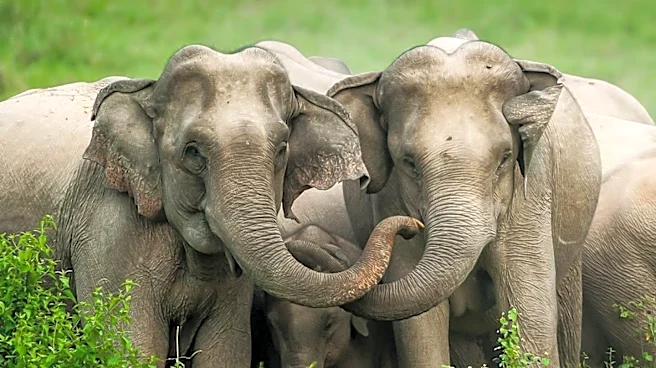
New research indicates that Asian elephants are experiencing increasingly isolated lives due to the fracturing of their social networks. A study led by Anastasia Madsen, published in the journal Science,
found that a gradual accumulation of losses in elephant populations has led to a sudden shift in social structures among female Asian elephants in Sri Lanka's Udawalawe National Park. Over 12 years, researchers observed a decline in elephant numbers due to deaths, permanent emigrations, and fewer new individuals entering the population. This demographic shift has caused the overall population to cross a 'critical threshold,' transforming large, densely connected social communities into smaller, more isolated social groupings. This change is concerning as elephants rely on these social bonds for foraging, information acquisition, and raising their young.
Why It's Important?
The fracturing of Asian elephant social networks has significant implications for the species' survival and conservation efforts. Elephants are highly social animals, and their community structures are crucial for their well-being and ecological functions. The observed 'tipping point' suggests that once a certain level of population decline is reached, the social fabric of these animals can rapidly unravel, making it harder for them to adapt and thrive. This research highlights the need for conservation strategies that not only focus on population numbers but also consider the intricate social dynamics of species. For ecosystems, the health of keystone species like elephants can have cascading effects, impacting vegetation, water sources, and other wildlife. The findings serve as a warning about the broader consequences of biodiversity loss on animal societies.
What's Next?
The researchers warn that the new social fracturing structure observed in Asian elephants may not be easily repaired. They emphasize the importance of recognizing these 'tipping points' where gradual changes lead to sudden, difficult-to-reverse shifts. Future studies will aim to understand these transformations in animal society structures, identify factors contributing to vulnerabilities, and develop more effective conservation strategies. This includes addressing threats like poaching, human-elephant conflict, habitat loss, and disruptions in habitat connectivity. The study also stimulates ongoing discussions about how to conserve elephant populations as human expansion encroaches on their historical territories, underscoring the need for integrated approaches that consider both ecological and social aspects of wildlife conservation.
Beyond the Headlines
The study's findings resonate beyond elephant conservation, offering insights into the resilience of social structures in various species, including humans. As co-author Shermin de Silva noted, social connectivity is vital for many social species, requiring the replacement of lost relationships over time to maintain resilient communities. The concept of a 'social structure tipping point' could be applied to other animal populations facing environmental pressures, providing a framework for early detection of social degradation. Furthermore, the research implicitly critiques the anthropocentric view of social networks, reminding us that complex social dynamics are not exclusive to humans and are fundamental to the survival and flourishing of many species. Understanding these dynamics can inform broader ecological management and highlight the interconnectedness of all life.