



What's Happening?
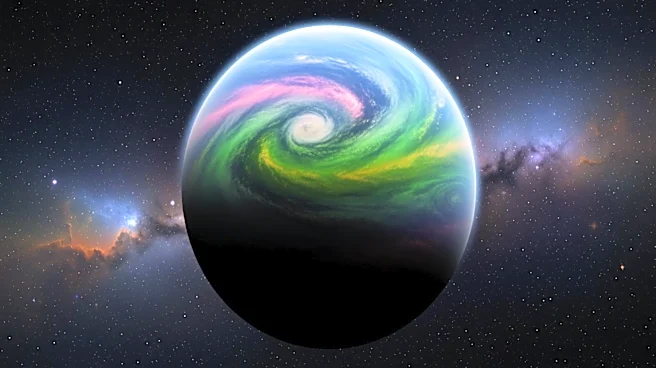
Astronomers have identified an exoplanet named Enaiposha, also known as GJ 1214 b, which challenges existing classifications of exoplanets. Initially categorized as a mini-Neptune, new observations suggest it resembles a 'super-Venus' due to its thick
atmosphere composed of hydrogen, helium, water, methane, and carbon dioxide. The planet, located 47 light-years away, has a metal-rich atmosphere with less hydrogen than expected. The discovery was made using data from the James Webb Space Telescope (JWST), revealing faint traces of molecules in the planet's spectrum. The findings suggest that Enaiposha's atmosphere is blanketed by haze and aerosols, making it difficult to analyze spectroscopically. This discovery highlights the complexity and diversity of exoplanets, suggesting that similar planets may exist in other star systems.
Why It's Important?
The discovery of Enaiposha is significant as it defies the conventional understanding of exoplanet classifications, particularly in the mini-Neptune category. This finding could lead to a reevaluation of how astronomers categorize and study exoplanets. The presence of complex metals and a thick atmosphere on Enaiposha suggests that there may be more diverse planetary types than previously thought. Understanding these unique characteristics can provide insights into the formation and evolution of planets, potentially aiding in the search for habitable worlds. The methods used to study Enaiposha's atmosphere could also be applied to other exoplanets, enhancing the ability to detect signs of life beyond our solar system.