
What's Happening?
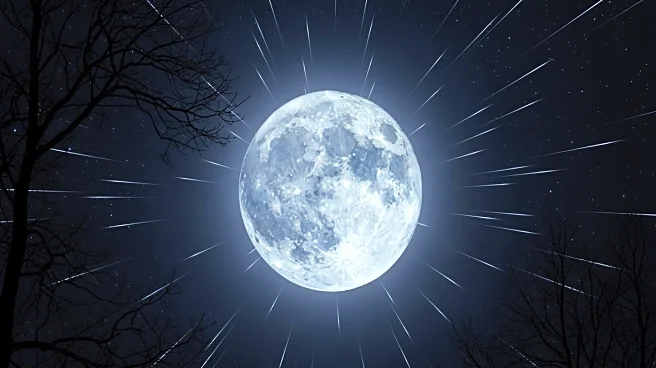
The first full moon of 2026, known as the wolf moon, will peak on January 3, coinciding with the Quadrantid meteor shower. The wolf moon, named for the increased howling of wolves during this time, will be
a supermoon, appearing larger and brighter as it is closer to Earth. This celestial event will make it challenging to view the Quadrantid meteor shower, which peaks from 4 to 7 p.m. ET on January 3. Despite the bright moonlight, sky watchers may still see up to five meteors per hour by facing northeast with the moon at their back. The Quadrantids are known for bright fireballs, although visibility in North America may be limited.
Why It's Important?
These celestial events offer a unique opportunity for sky watchers and astronomy enthusiasts to observe natural phenomena that highlight the beauty and complexity of our universe. The wolf supermoon and Quadrantid meteor shower serve as reminders of the interconnectedness of natural cycles and the cultural significance of lunar events. Such occurrences can inspire interest in astronomy and science, encouraging educational pursuits and public engagement with space exploration. Additionally, these events provide a moment of reflection and connection with nature, fostering a sense of wonder and curiosity about the cosmos.
What's Next?
Following the wolf supermoon and Quadrantid meteor shower, sky watchers can look forward to other meteor showers throughout the year, including the Lyrids in April and the Perseids in August. Each event offers different viewing conditions and opportunities to observe various celestial phenomena. As NASA prepares for the Artemis II mission, which aims to send astronauts around the moon, public interest in lunar exploration and space missions is likely to increase. These events may also inspire future scientific research and exploration initiatives.