






What's Happening?
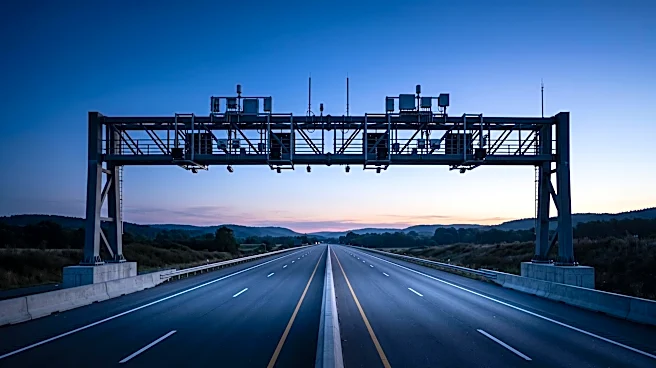
The Maryland Transportation Authority (MDTA) is grappling with approximately $818 million in unpaid tolls from out-of-state drivers, an issue that has become more pronounced since the COVID-19 pandemic. A recent audit revealed that the MDTA currently
lacks an effective recovery process for these outstanding tolls. Unlike in-state drivers, whose vehicle registrations can be withheld for unpaid tolls, collecting from out-of-state motorists requires cooperation from other states' motor vehicle administrations. MDTA Executive Director Bruce Gartner noted that cross-state collections are a widespread challenge in the toll industry due to differing enforcement mechanisms. Drivers from Virginia, Pennsylvania, New Jersey, and Florida account for the largest portions of the unpaid tolls.
Why It's Important?
The nearly $1 billion in uncollected tolls represents a significant loss of revenue for Maryland, impacting the state's ability to fund critical transportation infrastructure projects and maintenance. This financial shortfall could lead to increased burdens on in-state taxpayers or necessitate cuts in other state services. The issue also highlights a systemic challenge in interstate commerce and law enforcement, where jurisdictional boundaries complicate the collection of debts. The lack of robust reciprocity agreements between states creates a loophole that allows out-of-state drivers to evade financial responsibilities, undermining the fairness and effectiveness of the tolling system. This situation could prompt other states with similar tolling systems to review their own collection processes for out-of-state drivers.
What's Next?
State Delegate Ryan Nawrocki has called for a legislative hearing to investigate the MDTA's handling of the unpaid tolls, indicating potential political scrutiny and pressure for action. The MDTA is reportedly in discussions with Pennsylvania to formalize a more detailed agreement for toll collection, aiming to have it signed by the end of the calendar year. This could serve as a model for agreements with other states. Recommendations from the Department of Legislative Services include entering into more reciprocity agreements, contracting with third-party collection agencies, and referring unpaid tolls to the Central Collection Unit. These steps aim to establish more robust enforcement mechanisms and improve the recovery rate of outstanding funds.
Beyond the Headlines
This issue extends beyond mere financial collection, touching upon principles of interstate cooperation and the evolving landscape of transportation infrastructure funding. The reliance on tolls as a revenue source for maintaining and expanding vital transportation networks necessitates effective enforcement across state lines. The challenge of collecting from out-of-state drivers underscores the need for standardized interstate agreements and potentially federal intervention to streamline enforcement mechanisms. It also raises questions about the future of tolling systems in an increasingly mobile society and the technological solutions that could facilitate seamless and equitable collection. The situation could spur innovation in digital payment systems and cross-state data sharing to prevent similar revenue losses in the future.