




What's Happening?
A new study suggests that astronomers may have been incorrect about the primary mechanism that ended the 'Cosmic Dark Age,' the period when the universe was shrouded in an opaque fog of neutral hydrogen. Previously, it was thought that supernovas, the explosive
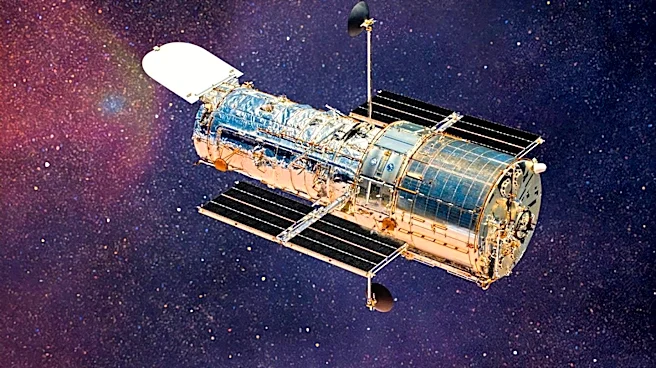
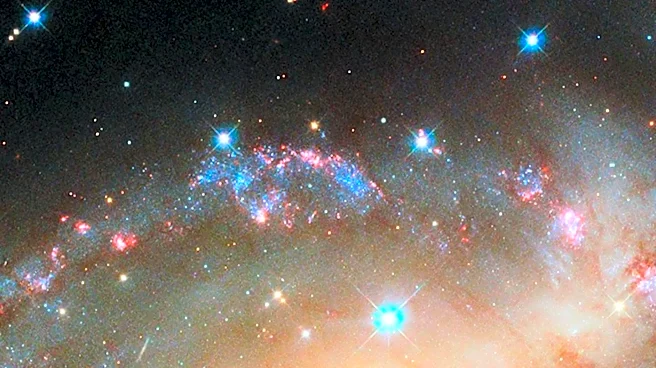
deaths of massive stars, were responsible for ionizing this hydrogen fog, allowing light to pass through. However, research published in 'Nature Astronomy' by Cody Carr and his team indicates that supernovas might have actually hindered this process by trapping Lyman continuum (LyC) photons, which are crucial for ionization. The study observed six star-forming galaxies, analogous to the early universe, using the Hubble Space Telescope. These observations revealed a two-phase process: initially, stellar winds from newly formed massive stars carved through galactic gas, allowing LyC light to escape. Later, as O-type stars died, their expelled material created a trap for LyC light, suggesting that the intense light from newborn stars, rather than supernovas, was the more significant factor in reionization.
Why It's Important?
This re-evaluation of the Epoch of Reionization is significant for astrophysics and our understanding of cosmic evolution. If supernovas did not drive the clearing of the cosmic fog but instead dampened it, it fundamentally alters our models of how the universe transitioned from its early, opaque state to the transparent, starlit cosmos we observe today. This shift in understanding could lead to revisions in cosmological simulations and theories regarding galaxy formation and the distribution of matter in the early universe. It also highlights the ongoing refinement of scientific understanding through new observational data and challenges long-held assumptions, impacting how future research in astronomy and cosmology will be conducted. The findings suggest that the initial burst of light from young stars played a more critical role than previously attributed to supernovas.
What's Next?
Future research will likely focus on obtaining additional galactic samples and higher-resolution observations across various wavelengths to further validate these findings. Astronomers will need to adjust existing cosmological simulations to incorporate this new understanding of the role of supernovas and stellar winds in the Epoch of Reionization. This could involve developing new models that better reflect the two-phase process identified in the study. The scientific community will also be looking for more evidence to confirm the precise mechanisms by which LyC photons escaped early galaxies and ionized the intergalactic medium. This ongoing investigation will be crucial for building a more accurate and complete picture of the universe's early history and its subsequent evolution.
Beyond the Headlines
The study's implications extend beyond the technical aspects of astrophysics, touching upon the nature of scientific inquiry itself. It underscores that even well-established theories can be challenged and refined with new evidence and advanced observational techniques. This continuous process of questioning and re-evaluating fundamental assumptions is central to scientific progress. The 'Cosmic Dark Age' represents a critical period in the universe's history, and understanding its end is key to comprehending the origins of galaxies, stars, and ultimately, life. This research highlights the complex interplay of cosmic forces and the intricate dance between stellar evolution and the large-scale structure of the universe, reminding us that our understanding of the cosmos is always evolving.