
What's Happening?
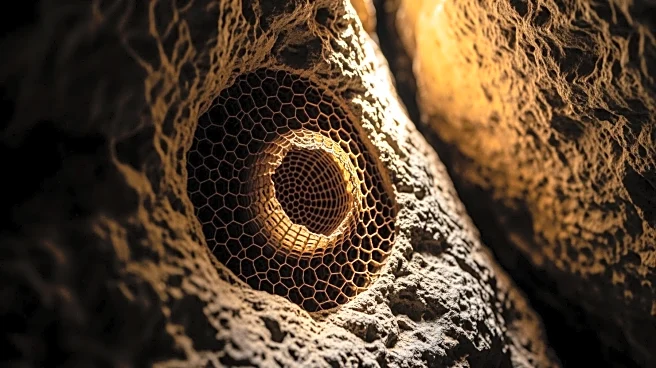
Paleontologists have uncovered a fascinating discovery in a cave on the Caribbean island of Hispaniola, where a fossilized jawbone of a capybara-like rodent, Plagiodontia araeum, was found to have been
used as a nesting site by a newly described species of burrowing bee, Osnidum almontei. This marks the first time ancient bees have been observed taking up residence in the pre-existing cavities of a fossil. The jawbone, believed to have been transported to the cave by an owl, was gradually buried under clay silt, during which time the teeth loosened and scattered. The bees utilized the dental alveoli, or tooth holes, as a multi-generational home. The discovery was made by paleontologist Lazaro Viñola Lopez at the Florida Museum of Natural History, who noted the unusually smooth surface inside one of the alveoli. Micro-computed tomography scans revealed repeated use of the same cavity, indicating nest fidelity among the bees.
Why It's Important?
This discovery provides significant insights into the nesting behavior of ancient bees, highlighting their opportunistic use of available resources for nesting. The findings suggest that the bees exhibited a high degree of nest fidelity, consistently selecting specific nesting sites. This behavior is crucial for understanding the ecological dynamics of ancient ecosystems and the role of bees in them. The presence of numerous nests throughout the sediment indicates that the cave served as a long-term nesting aggregation area for these solitary bees. Such discoveries can inform current conservation efforts by providing a historical context for the ecological roles of bees and their nesting preferences, which are vital for pollination and maintaining biodiversity.
What's Next?
Further research is likely to focus on exploring other potential nesting sites within the cave and surrounding areas to better understand the extent of the bees' nesting behavior and their ecological impact. Researchers may also investigate the environmental conditions that allowed for such nesting behavior and how these conditions have changed over time. This could provide valuable information for predicting how current and future environmental changes might affect bee populations and their ecological roles.
Beyond the Headlines
The discovery of bees nesting in fossilized bones opens up new avenues for studying ancient ecosystems and the interactions between different species. It challenges traditional views of fossilization and preservation, suggesting that fossils can provide more than just skeletal information. This finding also raises questions about the adaptability and resilience of bee species in the face of environmental changes, offering lessons for modern conservation strategies. Additionally, it highlights the importance of interdisciplinary research, combining paleontology, entomology, and ecology to uncover complex ecological histories.