



What's Happening?
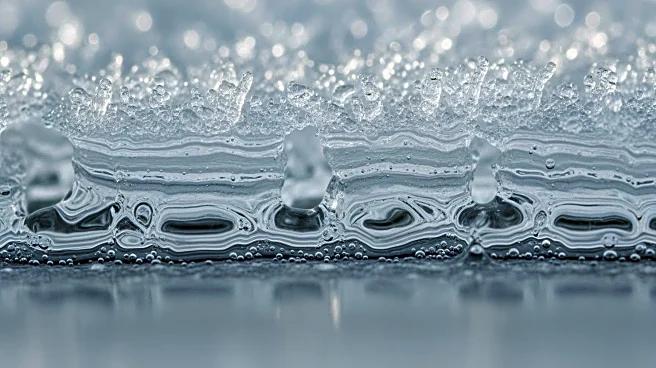
Researchers in China have resolved a long-standing mystery about the molecular surface structure of 'premelted' ice using a combination of machine learning and atomic force microscopy (AFM). This phenomenon, first noted by Michael Faraday over 170 years
ago, involves a liquid-like layer forming on ice surfaces at temperatures below freezing. The study, published in Physical Review X, reveals that an 'amorphous' layer forms on the ice surface, lacking the orderly lattice structure of crystalline ice. This discovery was made possible by integrating machine learning with AFM, allowing researchers to map out the topological surface landscapes at atomic scales.
Why It's Important?
This breakthrough has significant implications for understanding the properties of ice, such as friction, chemical reactivity, and atmospheric chemistry. The ability to resolve the microscopic structure of the premelted layer can lead to advancements in various fields, including cryopreservation and ice skating. The novel technique developed by the researchers could also be applied to study other disordered interfaces and phase transitions, potentially impacting the development of catalytic interfaces, functional materials, and biological systems.
Beyond the Headlines
The integration of machine learning with AFM represents a significant advancement in imaging technology, providing a powerful tool for investigating atomic-scale structures. This approach could redefine how scientists study disordered surfaces and phase transitions, offering new insights into material science and engineering. The discovery of the amorphous ice layer also challenges existing theories about ice's surface dynamics, prompting further research into its implications for environmental and industrial applications.