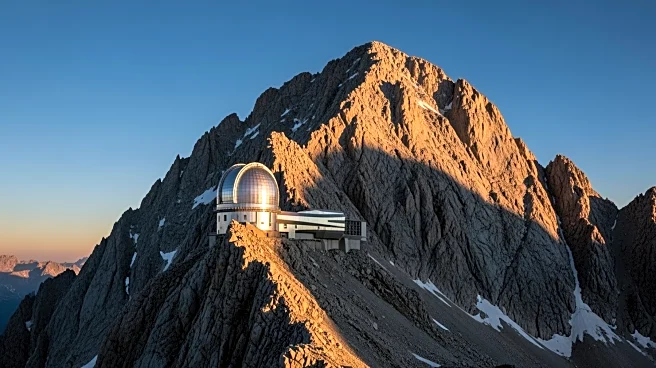




What's Happening?
A new particle detector is being developed in the Andes mountains of Peru to study ultra-high-energy cosmic neutrinos. Led by Carlos Argüelles-Delgado, the project aims to build the Tau Air-shower Mountain-Based Observatory (TAMBO), which will consist
of thousands of detectors spread across a steep canyon. This location is ideal for detecting cosmic neutrinos due to its natural shielding from background noise and its ability to convert neutrinos into detectable particles. The project seeks to uncover the origins of these mysterious particles, which are believed to come from violent cosmic events such as black holes. The initiative is part of a broader effort to understand the fundamental properties of neutrinos and their role in the universe.
Why It's Important?
The detection and study of cosmic neutrinos are vital for advancing our understanding of the universe's most energetic and enigmatic phenomena. Neutrinos, often referred to as 'ghost particles,' can provide insights into the processes occurring in distant galaxies and the nature of cosmic rays. By building TAMBO in Peru, researchers hope to capture these rare particles and explore their origins, potentially leading to breakthroughs in particle physics and cosmology. The project also emphasizes the importance of international collaboration and the integration of local communities in scientific endeavors, ensuring that the benefits of such research are shared and understood globally.
What's Next?
The TAMBO project is currently in the planning and pilot phase, with the full-scale telescope expected to be operational by the early 2030s. The team is addressing logistical challenges, such as deploying detectors in the rugged terrain and ensuring the project's sustainability and community involvement. As the project progresses, it will collaborate with other neutrino observatories worldwide, such as IceCube and KM3NeT, to enhance the detection and analysis of cosmic neutrinos. This collaboration aims to create a comprehensive network of observatories that can provide continuous sky coverage and improve our understanding of these elusive particles.
Beyond the Headlines
The development of TAMBO highlights the intersection of science and culture, as the project seeks to respect and integrate local knowledge and traditions. By acknowledging the cultural significance of the Andes and engaging with local communities, the project aims to avoid the pitfalls of past scientific endeavors that have overlooked indigenous perspectives. This approach not only fosters goodwill but also enriches the scientific process by incorporating diverse viewpoints and methodologies. The project serves as a model for how scientific research can be conducted responsibly and inclusively, paving the way for future collaborations that honor both scientific and cultural heritage.