


What's Happening?
Laura Loomer, a figure known for her provocative and often conspiratorial views, particularly concerning the 9/11 attacks, has seen a significant rise in her political influence. Once a marginal figure, Loomer is now treated as an informal advisor to President
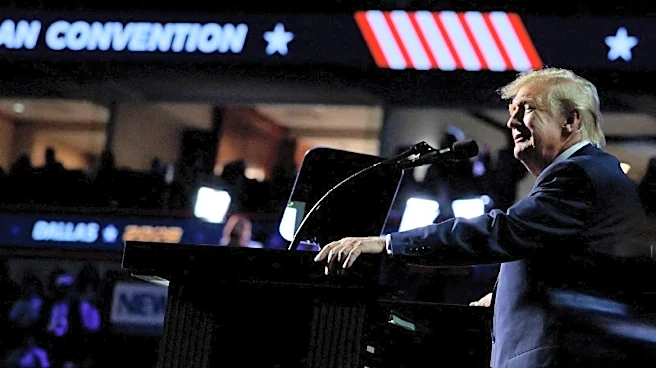
Trump. Her ascent is highlighted by her prominent presence at the Dallas convention, where she was heavily interviewed, and her recent access to interview Ukrainian President Volodymyr Zelensky. Loomer has a history of promoting Islamophobic, anti-immigrant, anti-Semitic, and anti-LGBTQ+ rhetoric. She has leveraged controversy to gain media attention and increase her follower count, framing past bans from social media platforms as evidence of her revealing 'uncomfortable truths.' Loomer recently shifted her stance on Ukraine, admitting she was previously 'blinded by Putin's propaganda,' and claims her visit inspired Steve Witkoff and Jared Kushner to travel to Kyiv.
Why It's Important?
Loomer's growing influence is significant as it indicates a shift in the political landscape where controversial figures can gain access to high-level political circles and impact policy discussions. Her role as an informal advisor to President Trump suggests that her views, despite their controversial nature, may find an audience within the administration. Her ability to secure an interview with President Zelensky, a global leader, underscores her increasing media prominence and potential to shape narratives. The fact that she claims to have inspired high-profile individuals like Witkoff and Kushner to visit Ukraine, even if indirectly, highlights the potential for non-traditional political actors to influence foreign policy and diplomatic efforts. This trend raises questions about the vetting processes for informal advisors and the broader implications for political discourse and international relations.
What's Next?
Loomer's continued presence and influence within President Trump's orbit suggest she will likely remain a visible and vocal figure in U.S. politics. Her ability to attract media attention and engage with high-profile individuals indicates that her controversial views will continue to be amplified. Future developments may include further attempts by Loomer to influence policy or personnel decisions, as evidenced by her past actions in reportedly causing the dismissal of National Security Agency officials. Her self-proclaimed role as a 'reporter' and her recent shift on Ukraine could lead to more engagement in international affairs, potentially shaping public opinion on critical foreign policy issues. The extent to which her influence grows will depend on her continued access to political figures and her ability to maintain media relevance through her provocative approach.
Beyond the Headlines
Loomer's rise reflects a broader phenomenon in contemporary U.S. politics where the lines between traditional journalism, activism, and political influence are increasingly blurred. Her strategy of using provocation to generate media attention and build a political identity as a 'martyr of censorship' highlights the challenges faced by mainstream media and political institutions in navigating the digital age. The acceptance of such figures into informal advisory roles raises ethical questions about the standards of political discourse and the potential for the normalization of extreme views. Her ability to influence high-level officials and international relations, despite a lack of formal credentials or traditional political experience, points to a changing dynamic in how power and influence are wielded in the U.S. and globally. This trend could further erode public trust in established institutions and contribute to a more polarized political environment.