




What's Happening?
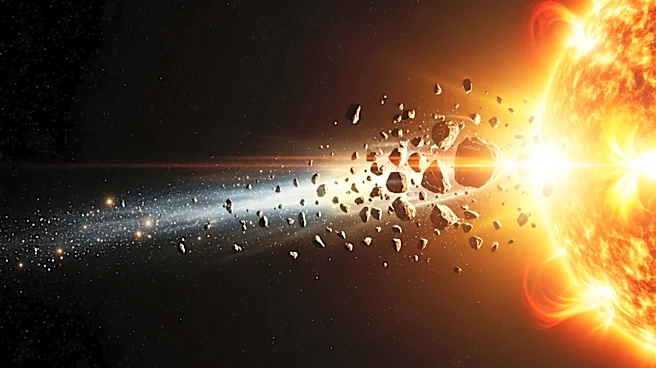
Comet MAPS, once anticipated to be a bright spectacle in the night sky, has disintegrated after a close approach to the sun. Known as a Kreutz sungrazer, the comet was expected to pass within 100,000 miles of the sun's surface. However, it underwent a cataclysmic
fragmentation just hours before reaching its closest point, known as perihelion. This type of comet is known for its close proximity to the sun, often resulting in their destruction. The disintegration of Comet MAPS was observed using various space telescopes, including the Solar and Heliospheric Observatory (SOHO) and the GOES 19 satellite, which captured the comet's final moments as it brightened and then disappeared, leaving behind a cloud of dust.
Why It's Important?
The destruction of Comet MAPS highlights the dynamic and often unpredictable nature of celestial bodies within our solar system. Such events provide valuable insights into the behavior and composition of comets, particularly those that come close to the sun. The study of Kreutz sungrazers like Comet MAPS can enhance our understanding of cometary evolution and the potential risks they pose to Earth. Additionally, these observations contribute to the broader field of astronomy by offering real-time data on how comets interact with solar forces. The event underscores the importance of continuous monitoring and research to anticipate and understand similar occurrences in the future.
What's Next?
Following the disintegration of Comet MAPS, astronomers will likely analyze the data collected during its final approach to the sun to gain further insights into its composition and the forces that led to its fragmentation. This analysis could inform future studies of Kreutz sungrazers and other comets with similar trajectories. Additionally, the event may prompt further advancements in observational technology and techniques to better predict and monitor the behavior of comets as they approach the sun. The findings could also contribute to the development of strategies for mitigating potential threats posed by comets and other celestial bodies to Earth.