





What's Happening?
German Defense Minister Boris Pistorius has refuted accusations that Germany favors its national arms manufacturers over broader European defense cooperation. Speaking at the Berlin Security Conference, Pistorius addressed criticism from Marie-Agnes Strack-Zimmermann,
chair of the European Parliament's Committee on Security and Defence, who suggested Germany was too focused on domestic procurement. Pistorius argued that protecting national defense industries is a common concern among all EU member states. He acknowledged that while European countries advocate for closer defense cooperation and joint projects, each state ultimately seeks to ensure its own industry benefits from specific contracts. The European Defence Agency reported that in 2025, EU countries spent €115 billion on military equipment, with only 24% of that allocated to joint procurement. Brussels aims to increase this share to at least 40% by 2030, and has launched a €150 billion SAFE loan program to encourage joint weapons purchases. However, national governments, including Poland, continue to prioritize domestic production, with Poland intending to direct 89% of its nearly €44 billion in SAFE funds to its own industry. Pistorius emphasized the responsibility of governments to protect their economies and industrial enterprises.
Why It's Important?
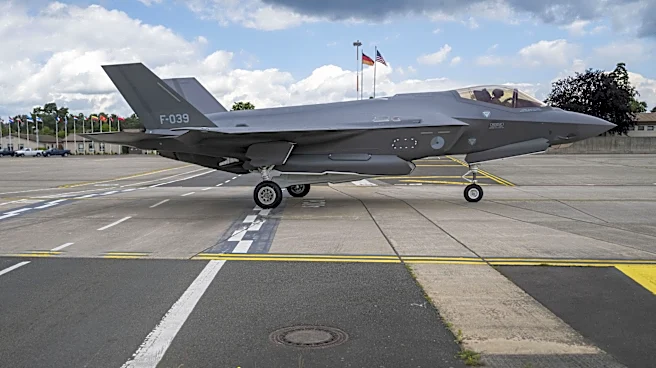
This debate highlights a significant tension within the European Union regarding defense policy and industrial strategy. While there's a stated goal for greater European defense integration and joint procurement, national interests in protecting domestic industries often take precedence. For the U.S., this dynamic can impact transatlantic defense cooperation and the effectiveness of NATO. A fragmented European defense market, where countries prioritize national suppliers, can lead to inefficiencies, duplication of efforts, and potentially slower modernization of military capabilities. This could place a greater burden on U.S. defense spending and resources within NATO, as European allies might not achieve the interoperability and scale needed for collective defense. Conversely, a stronger, more integrated European defense industry could become a more reliable partner for the U.S., sharing the load in global security challenges. The U.S. defense industry could also face increased competition from a more unified European market, or find new opportunities through partnerships if European integration progresses.
What's Next?
The EU's push to increase joint procurement to 40% by 2030, supported by the €150 billion SAFE loan program, will continue to test the balance between national industrial interests and European integration. Future discussions and negotiations within the EU will likely focus on how to incentivize member states to prioritize joint projects without undermining their domestic defense sectors. The outcome of these efforts could determine the future structure and capabilities of European defense. If national protectionism persists, it may lead to continued fragmentation and potentially strain relations with the U.S. regarding burden-sharing within NATO. Conversely, if the EU successfully fosters greater joint procurement, it could lead to a more robust and self-reliant European defense capability, potentially altering the dynamics of transatlantic security cooperation and creating new opportunities or challenges for U.S. defense contractors.
Beyond the Headlines
The underlying issue extends beyond mere procurement figures; it touches upon the very concept of European sovereignty and strategic autonomy. The desire to protect national industries is often intertwined with national security concerns, job creation, and technological independence. This tension reflects a broader challenge within the EU: how to achieve collective strength and efficiency while respecting the individual economic and political interests of member states. The debate also has ethical dimensions, as it involves the allocation of significant public funds to the arms industry and the potential for these investments to fuel conflicts or contribute to global instability. The long-term implications could include a redefinition of Europe's role on the global stage, its relationship with major powers like the U.S. and China, and the future of its industrial base in a rapidly evolving geopolitical landscape. The push for 'ITAR-free' production lines by companies like Rheinmetall, as mentioned in related contexts, further underscores a desire for greater independence from U.S. export rules, indicating a strategic shift towards self-reliance.