







What's Happening?
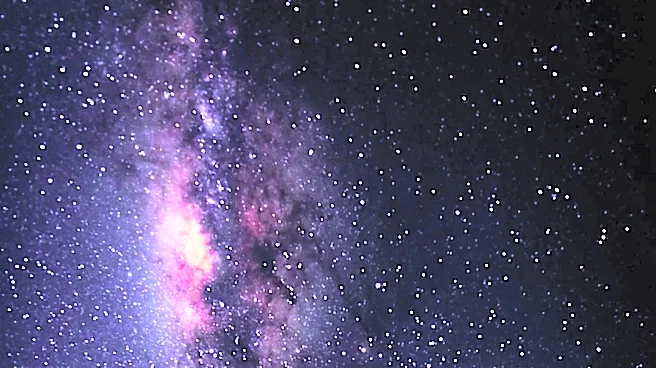
The IceCube Neutrino Observatory, located at the South Pole, has produced the first-ever neutrino image of the Milky Way galaxy. This groundbreaking image, derived from 10 years of observational data (May 2011 through May 2021), reveals a strong signal
of high-energy neutrinos concentrated along the galactic plane and towards the center of the Milky Way. Researchers utilized deep-learning tools to analyze a vast dataset of 59,592 events, significantly enhancing their ability to identify faint galactic signals amidst a large background of atmospheric particles. The findings, published in Science, provide compelling evidence that the Milky Way itself is a source of high-energy neutrinos. This new mapping method complements existing observations of the galaxy in starlight, radio waves, and gamma rays, offering a unique perspective on cosmic-ray interactions within our galaxy. The analysis tested three models for diffuse neutrino emission, all of which showed evidence above background expectations, though the data could not definitively distinguish between them or pinpoint individual sources.
Why It's Important?
This achievement marks a significant advancement in astrophysics and our understanding of the universe. Neutrinos, often called 'ghost particles' due to their rare interaction with matter, act as cosmic messengers, traveling through space with minimal disturbance. This allows them to trace cosmic-ray interactions in regions where photons might be absorbed or altered, providing a clearer picture of high-energy processes within the Milky Way. The strong evidence that our own galaxy produces high-energy neutrinos challenges and refines existing models of cosmic-ray behavior and emission distribution, particularly near the Galactic Center, which may be more active than previously thought. This new observational capability opens up new avenues for studying the origins of cosmic rays and the extreme environments within our galaxy, potentially leading to a deeper understanding of fundamental physics and the universe's most energetic phenomena. The use of deep learning in this research also highlights the growing importance of artificial intelligence in scientific discovery.
What's Next?
The immediate next steps for researchers involve further investigation into whether specific galactic objects contribute to the observed neutrino signal and to what extent diffuse interactions with interstellar gas are responsible. While the current data strongly supports the Milky Way as a neutrino source, pinpointing individual origins remains a challenge. Future research will aim to refine the Milky Way's neutrino map, search for specific galactic sources, and connect neutrino observations with cosmic rays and gamma rays. Plans are also underway for IceCube-Gen2, an upgrade to the IceCube observatory, which is expected to provide significantly greater sensitivity for future studies of events within the galaxy. This enhanced capability will be crucial for identifying individual neutrino sources and distinguishing between different emission models, ultimately leading to a more comprehensive understanding of the high-energy universe.
Beyond the Headlines
The ability to 'see' the Milky Way through neutrinos offers a profound shift in astronomical observation, moving beyond electromagnetic radiation to particle astronomy. This new window into the cosmos could reveal hidden aspects of galactic dynamics and high-energy particle acceleration that are otherwise obscured. The discrepancy between the observed neutrino flux and predictions from simpler neutral-pion models suggests that our understanding of cosmic-ray propagation near the Galactic Center or their energy spectrum may need revision. This could lead to a re-evaluation of the processes that generate high-energy particles in our galaxy. Furthermore, the success of deep learning in extracting this faint signal from vast amounts of data underscores a broader trend in scientific research, where advanced computational methods are becoming indispensable for making sense of complex datasets and pushing the boundaries of discovery. This interdisciplinary approach, combining astrophysics with cutting-edge AI, is likely to drive many future breakthroughs.