



What's Happening?
A team of researchers led by Dominik Gräff from the University of Washington has deployed a 10-kilometer fiber-optic cable across a fjord in southern Greenland to monitor glacier activity. The cable, positioned near the Eqalorutsit Kangilliit Sermiat
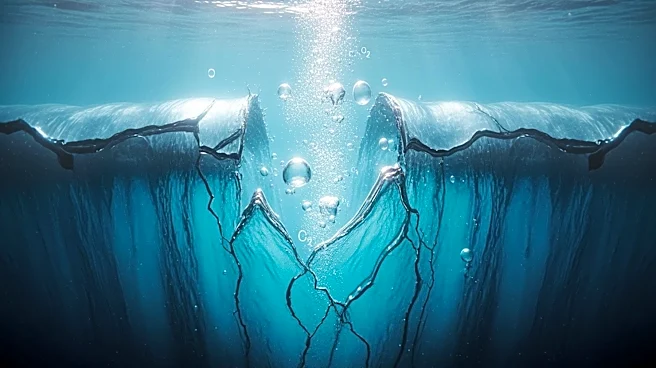
glacier, has detected 56,000 iceberg break-offs in just three weeks. This innovative approach provides detailed insights into how glaciers fracture, collapse, and reshape the ocean around them. The cable uses distributed acoustic sensing (DAS) and distributed temperature sensing (DTS) to capture vibrations and temperature changes, allowing researchers to track events lasting only milliseconds. This method offers a continuous record of calving activity, revealing the sequence of internal cracking, ice detachment, and subsequent underwater waves.
Why It's Important?
The deployment of the fiber-optic cable represents a breakthrough in glaciology, offering unprecedented insights into the dynamics of glacier calving. Understanding these processes is crucial for predicting the impact of climate change on polar regions and global sea levels. The data collected can improve models of glacier behavior, helping scientists anticipate future changes in ice mass and their implications for coastal communities. This research highlights the importance of innovative technologies in advancing climate science and underscores the need for continued investment in monitoring and understanding Earth's changing environments.
What's Next?
The success of this experiment may lead to the deployment of similar monitoring systems in other glacial regions, providing a more comprehensive understanding of global ice dynamics. Researchers will likely analyze the vast amount of data collected to refine models of glacier behavior and improve predictions of sea-level rise. The findings could inform policy decisions related to climate change mitigation and adaptation strategies. As the technology evolves, it may also be applied to other environmental monitoring challenges, enhancing the ability to track and respond to changes in Earth's ecosystems.