


What's Happening?
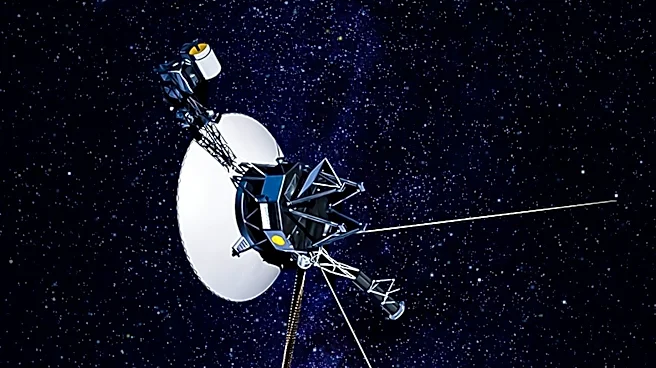
The Moon is exhibiting signs of rust, specifically hematite (iron oxide), despite lacking a substantial atmosphere and liquid water, which are typically necessary for rust formation. Data from India’s Chandrayaan-1 orbiter, particularly its Moon Mineralogy

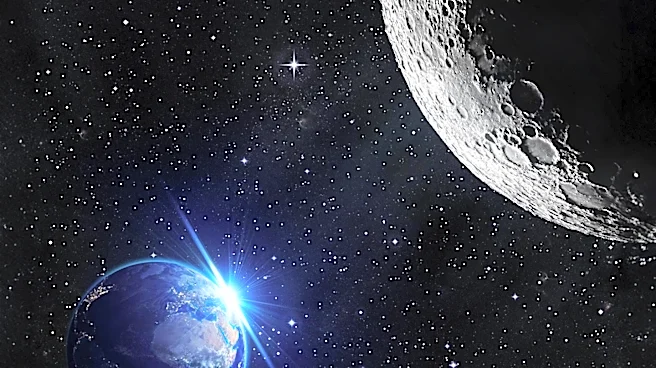
Mapper (M3), identified hematite at high lunar latitudes, predominantly in the polar regions between 75 and 90 degrees latitude. This rust is more prevalent on the near side of the Moon, which consistently faces Earth. The leading scientific explanation posits that oxygen ions escaping Earth's upper atmosphere are transported to the Moon via Earth's magnetotail. This magnetotail also plays a crucial role by temporarily blocking the solar wind, which is rich in hydrogen (a reducing agent that would inhibit rust), for several days each month when the Moon passes through it. This creates a recurring window during which lunar iron can oxidize. Laboratory experiments have further demonstrated that oxygen implantation can lead to hematite formation on iron-bearing samples even without liquid water, supporting the proposed mechanism.
Why It's Important?
This discovery challenges conventional understanding of lunar geochemistry and highlights the profound interconnectedness between Earth and its natural satellite. The presence of rust on the Moon, attributed to terrestrial oxygen, suggests that Earth's atmospheric particles can travel vast distances and significantly alter the lunar surface over immense spans of time. This phenomenon could provide a unique historical record of Earth's atmospheric evolution. If lunar hematite was indeed formed from terrestrial oxygen, analyzing its isotopic proportions could offer insights into Earth's atmospheric history spanning billions of years. Furthermore, it underscores the complex interplay of solar wind, planetary magnetic fields, and atmospheric escape in shaping celestial bodies. The findings could influence future lunar exploration missions, particularly those focused on understanding lunar geology and the potential for in-situ resource utilization, as the distribution and formation of minerals like hematite could have implications for future human settlements or scientific endeavors on the Moon.
What's Next?
Future research will likely focus on obtaining uncontaminated polar samples from the Moon to definitively confirm the source of the oxygen in the hematite. Analyzing these samples could provide direct evidence of whether the oxygen originated from Earth and when the oxidation occurred. Scientists will also aim to determine the precise combination of ion implantation, hydration, and impact heating that contributed to the rust formation. Further laboratory experiments will continue to refine the understanding of the chemical processes involved, particularly the interplay between oxygen ions, trace water, and micrometeoroid impacts. The distribution of hematite, especially the remaining presence on the far side of the Moon, suggests that other local processes or impacts might also contribute to its formation, warranting further investigation. This ongoing research will help to solidify the 'leading explanation' and potentially uncover additional mechanisms influencing lunar surface chemistry.
Beyond the Headlines
The discovery of rust on the Moon, driven by Earth's atmospheric escape and magnetic field, offers a fascinating perspective on planetary interactions and the long-term consequences of seemingly subtle processes. It highlights that even in the vacuum of space, celestial bodies are not isolated but are constantly influenced by their cosmic neighbors. This phenomenon could have broader implications for understanding the evolution of other planetary systems, where similar interactions between a planet and its moons might occur. Ethically, it prompts reflection on humanity's impact on its cosmic environment, even if unintentional and on a geological timescale. The idea that Earth's 'breath' is literally rusting its companion in space adds a poetic dimension to our understanding of the solar system. It also underscores the power of remote sensing and laboratory simulations in unraveling complex astrophysical mysteries, pushing the boundaries of what we can learn about the universe without direct human presence.