







What's Happening?
The Indian Navy has significantly expanded its diplomatic reach through a series of bilateral and multilateral naval exercises across the Indo-Pacific, Europe, and beyond in 2026. These engagements, which include SAMUDRA LAKSAMANA with Malaysia, SLINEX
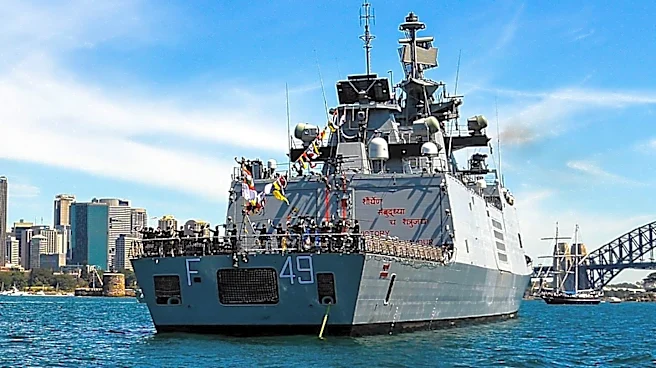
with Sri Lanka, the ASEAN Defence Ministers’ Meeting-Plus (ADMM-Plus) maritime security activity in the Philippines, the second ASEAN-India Maritime Exercise (AIME-2026), VARUNA with France, and INDRA with Russia, demonstrate India's growing maritime outreach. The exercises focus on enhancing operational coordination, strengthening interoperability, and exchanging professional expertise through complex maneuvers, air operations, special forces drills, and humanitarian assistance scenarios. Notably, the INS Sahyadri, an Indian stealth frigate, participated in multiple exercises, including INDRA with Russia and MALABAR with the Quad nations (U.S., Japan, Australia), showcasing India's ability to engage with diverse partners while maintaining strategic autonomy.
Why It's Important?
These extensive naval exercises are a critical instrument of India's foreign policy, projecting its influence and commitment to maritime security across various regions. For the U.S. and its allies, India's expanding naval diplomacy contributes to a more stable and secure Indo-Pacific, particularly in countering potential challenges to freedom of navigation and a rules-based international order. The ability of the Indian Navy to conduct concurrent engagements with Western partners, Russia, and Global South countries demonstrates a flexible approach to defense diplomacy, allowing cooperation where interests converge without implying identical strategic alignments. This strengthens India's profile as a maritime security contributor and a convenor of regional dialogue, which is vital for addressing complex maritime challenges such as disaster response, humanitarian assistance, and counter-piracy efforts. The exercises also provide practical opportunities for participating navies to build lasting trust and improve operational coordination, making coordinated responses more feasible in times of crisis.
What's Next?
The Indian Navy is expected to continue its robust schedule of naval exercises, further deepening its relationships with existing partners and potentially forging new ones. The ongoing MALABAR 2026 exercise with the Quad nations off Japan signifies a continued focus on multilateral cooperation in the Indo-Pacific. These exercises will likely evolve to address emerging maritime threats and technological advancements, requiring continuous adaptation of procedures and training. India's ability to convene maritime cooperation, as demonstrated by events like MILAN 2026, suggests it will play an increasingly central role in shaping the regional security environment. The diplomatic message conveyed by these exercises will continue to be that relationships can deliver practical outcomes, fostering a network of cooperation that supports India's ambition to shape a secure and cooperative Indo-Pacific.
Beyond the Headlines
The Indian Navy's expansive exercise calendar highlights a nuanced approach to international relations, where military cooperation serves as a tool for diplomacy without necessarily entailing formal alliances. This strategy allows India to maintain strategic autonomy while engaging with a wide array of partners, including those with differing geopolitical assessments. The participation of a single Indian frigate, INS Sahyadri, in exercises with both Russia and the Quad nations within weeks, is a clear illustration of this approach. This flexibility is particularly relevant in an Indo-Pacific marked by competing interests, where India seeks to balance its relationships to advance its national interests. The long-term impact of these engagements extends beyond military readiness, fostering professional exchanges and personal connections that build diplomatic capital and sustain cooperation long after an exercise concludes. This less visible aspect of naval diplomacy is crucial for building enduring trust and shared expectations about responsible conduct at sea.