





What's Happening?
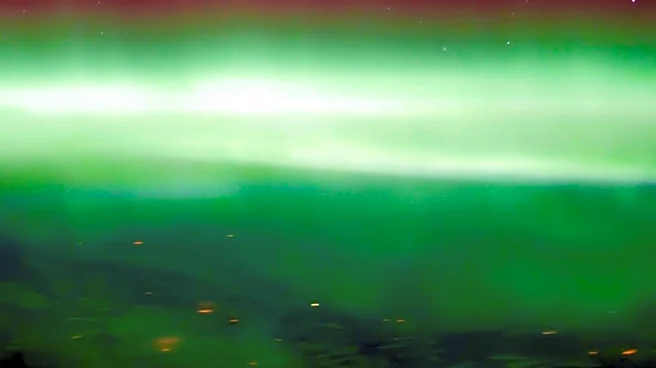
The European Space Agency (ESA) SMILE spacecraft has successfully captured its first ultraviolet image of an auroral substorm. This achievement marks a significant milestone for the mission, which is a collaborative effort between European and Chinese
teams. Nicknamed "Inspector SMILE," the spacecraft is designed to investigate the interaction between the solar wind and Earth's magnetic environment. Its ultraviolet aurora imager (UVI) has been successfully commissioned and is now fully operational. The UVI has provided a continuous view of the northern auroral ring in ultraviolet light, a capability not seen since 2008. This allows scientists to observe the auroral oval as a whole, rather than in fragmented sections, offering a comprehensive perspective on these dynamic phenomena. The first UV observation specifically shows an auroral substorm, which is a rapid change in the aurora caused by the release and redistribution of energy within Earth's magnetosphere.
Why It's Important?
The successful commissioning and initial imaging by the SMILE spacecraft are crucial for advancing our understanding of space weather and its impact on Earth. The ability to capture the entire auroral oval in ultraviolet light provides an unprecedented view of how solar wind activity disturbs Earth's magnetic field. This comprehensive perspective is vital because the shape and brightness of the auroral oval change significantly during such disturbances. By tracking these changes from space, scientists can gain deeper insights into how energy moves through Earth's near-space environment. Ultraviolet observations are particularly effective for studying auroras because Earth's atmosphere absorbs much of this radiation, making direct observation from above essential. This mission will help researchers better predict and mitigate the effects of space weather on critical infrastructure, including satellites, communication systems, and power grids, which are increasingly vulnerable to geomagnetic storms.
What's Next?
With the ultraviolet camera now fully operational, the SMILE spacecraft is poised to begin its primary scientific operations. The mission's main goal is to continuously observe the full auroral oval around the northern magnetic pole. This ongoing data collection will provide researchers with a broader and more complete picture of how the solar wind affects Earth's magnetic shield. Scientists will analyze the changes across the entire oval to understand the complex relationship between the Sun and Earth's magnetic field. The data gathered by SMILE is expected to contribute significantly to space weather forecasting models, potentially leading to improved warnings for geomagnetic events. Future research will likely involve integrating SMILE's observations with data from ground-based observatories and other space missions to create a more holistic understanding of Sun-Earth interactions.
Beyond the Headlines
The SMILE mission represents a significant step forward in international scientific collaboration, bringing together European and Chinese expertise to address a common scientific challenge. Beyond its immediate scientific objectives, the mission highlights the growing importance of understanding and predicting space weather. As humanity becomes more reliant on space-based technologies, the economic and societal implications of geomagnetic storms are increasing. The insights gained from SMILE could inform the design of more resilient space infrastructure and enhance the protection of assets in orbit and on Earth. Furthermore, the mission contributes to the broader field of heliophysics, deepening our fundamental knowledge of the universe and the forces that shape our solar system. The continuous, full-ring observation of the aurora also offers a unique opportunity to study the long-term trends and variations in auroral activity, which could reveal subtle changes in Earth's magnetosphere over time.