



What's Happening?
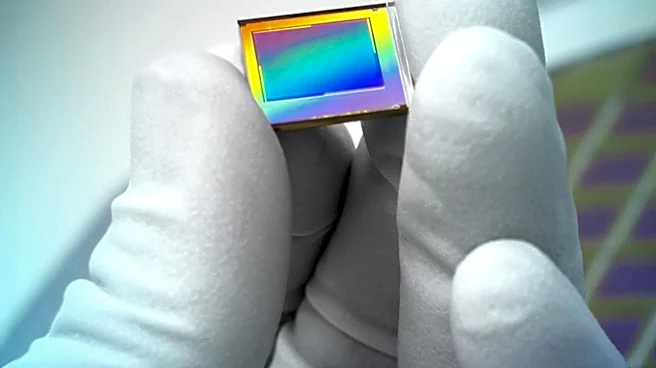
Researchers from Heriot-Watt University, in collaboration with an international team, have developed a tiny glass photonic chip that successfully combines starlight from two telescopes at California’s CHARA Array. This device, part of the CHARIOT instrument,
is only a few centimeters across and uses ultrafast-laser inscription to create light-guiding channels, or waveguides, within Infrasil quartz glass. These waveguides precisely route incoming starlight, allowing for the recording of interference patterns. The CHARIOT instrument measured bright-star interference signals with better than 1% precision and detected fainter targets than its predecessor, extending fringe detection to stars with a K-band magnitude of 5.212. This technology moves compact optical components from laboratory development into practical astronomical observing, demonstrating a new method for linking telescopes and extracting fine details from overlapping light waves.
Why It's Important?
This development is crucial for advancing astronomical interferometry, a technique that significantly enhances the ability of telescopes to distinguish fine details in distant celestial objects. By integrating complex optical functions into a small, stable glass chip, the CHARIOT instrument offers a more compact and less environmentally sensitive alternative to traditional mirror and lens arrangements. This innovation could lead to more precise measurements of stellar properties, such as the apparent size of stars and the characteristics of surrounding emissions. The ability to detect fainter targets and achieve high precision is vital for studying phenomena like faint, hot dust around other stars, which can provide insights into planetary systems, and resolving close stellar companions to determine their masses. The swappable nature of these chips also provides a practical testbed for comparing new photonic components under real observing conditions, accelerating the development of future astronomical instruments.
What's Next?
Future plans for the CHARIOT instrument include several improvements aimed at increasing sensitivity and calibration. Researchers intend to shorten output fibers to reduce light loss and integrate another instrument to track atmospheric changes during measurements, which can affect observation quality. Longer-term goals involve combining beams from four telescopes and cooling the beam combiner to minimize background noise, potentially supporting advanced techniques like nulling interferometry to suppress bright starlight and investigate fainter nearby emissions. While the current work establishes the design and initial performance, the next engineering challenge is to maintain bright-star precision while reliably measuring substantially fainter targets. This ongoing development will pave the way for more ambitious scientific applications, including the direct study of planets around other stars, though this remains a distant ambition.
Beyond the Headlines
The successful deployment of this photonic chip highlights a broader trend in scientific instrumentation towards miniaturization and integration, leveraging advanced materials and fabrication techniques. This approach not only reduces the physical footprint and complexity of astronomical equipment but also enhances its stability and precision by minimizing environmental disturbances. The use of ultrafast-laser inscription to create waveguides within glass represents a significant technological leap, offering a versatile platform for various optical applications beyond astronomy. This innovation could inspire similar integrated solutions in other fields requiring high-precision optical manipulation, such as quantum computing, medical imaging, and telecommunications. The emphasis on modular, swappable components also points to a future where scientific instruments are more adaptable and upgradable, fostering continuous innovation and reducing the cost of technological advancement.